What is breast augmentation?
It is the surgery that increases the volume and improves the shape of the breast, either by placing silicone breast implants or through fat transfer (grafting the own fat of the patient, harvested from another area such as the abdomen or flanks).
The choice between techniques —or their combination— depends on the desired volume, the amount of breast tissue and body fat available, and the expectations of each patient. It is one of the most requested aesthetic surgeries for restoring projection lost after pregnancy, breastfeeding or weight change.
What breast augmentation techniques does Dr. Arístides Arellano use?
- Breast implants: selected by profile (low, moderate or high, which determines how much forward projection the implant has) and placement plane (subglandular, beneath the gland; or submuscular / dual plane, beneath the pectoral muscle). The decision is made at the assessment based on body type, the amount of native tissue and the desired result.
- Incision route: the most used incision is the inframammary (in the fold beneath the breast), though the periareolar (areola border) and transaxillary (armpit) routes also exist. The choice depends on anatomy and is defined at consultation.
- Breast augmentation with fat (fat transfer): fat is harvested from another area by liposuction, processed and reinjected into the breast. It is an alternative for those seeking a moderate, natural increase without an implant, who also wish to improve the contour of the donor area.
What types of breast implant are there and how do they differ?
The word «implant» covers many different options. At your assessment, Dr. Arístides Arellano chooses the implant that best fits your chest, your tissue and the result you want, combining these variables:
- By content: cohesive silicone gel —the most used today; they hold their shape and feel natural, including high-cohesivity «gummy bear» types— or saline solution.
- By shape: round (more projection and upper-pole fill) or anatomical teardrop (a more natural profile).
- By surface: smooth, textured or nanotextured (such as Motiva’s SmoothSilk® surface).
- By profile or projection: low, moderate, high or extra-high, which defines how far forward the implant projects.
- Ergonomic ranges: implants like Motiva Ergonomix® adapt to body movement, for a more natural result standing and at rest.
Which implant brands are used and what warranty do they carry?
Dr. Arístides Arellano uses only brand-name breast implants, medical-grade, manufactured by the world’s leading companies and registered with COFEPRIS (Mexico’s health authority) for legal, safe use in Mexico.
The brands he uses include Allergan Natrelle®, Mentor® (Johnson & Johnson), Motiva® (Establishment Labs) and Nagor® / Eurosilicone® (GC Aesthetics). These manufacturers back their implants with a 10-year manufacturer warranty, plus additional protection programs.
Every implant comes with its card and serial number, certifying its brand, origin and traceability. A safe augmentation starts with an original, brand-name implant backed by the manufacturer —not the cheapest option—; be wary of any implant without health-registry approval.
How is a breast augmentation performed and how long does it take?
The procedure is performed under general anaesthesia in a hospital operating room. It lasts approximately 1.5 to 2.5 hours when implants are used, and may take longer when combined with fat transfer. It is usually outpatient or a short hospital stay (24 hours of observation).
All surgery carries risk and requires prior medical assessment. Results may vary according to each patient, their baseline anatomy and the technique chosen.
Augmentation with breast drooping? (Mastopexy)
If, besides adding volume, you also want to correct breast drooping (ptosis) —common after pregnancy or weight loss— your assessment may include a mastopexy, alone or combined with implants. It is a different procedure from simple augmentation, with its own technique and reference price, assessed according to your anatomy at consultation.
Who is a good candidate for breast augmentation?
- Breasts with little volume, asymmetry or loss of projection after pregnancy, breastfeeding or weight change.
- Good general health, with no contraindications to surgery.
- For breast fat transfer: sufficient body fat available in donor areas.
- Realistic expectations about size and shape, reviewed in detail at the assessment.
- Not actively breastfeeding and not planning a pregnancy in the short term.
What post-surgical treatments are recommended afterwards?
For a more comfortable recovery, Dr. Arístides may recommend manual lymphatic drainage and, in the case of breast fat transfer, additional treatments over the fat donor area. See the full guide: Post-surgical recovery and care.
Which is better: implants or augmentation with your own fat?
It depends on how much volume you want and how much fat you have available, not on which technique is "better" in the abstract. Implants give a predictable increase of whatever magnitude your chest allows, and the result holds over time. Fat transfer to the breast gives a moderate increase with a very natural feel, and improves the contour of the donor area along the way, because the fat is harvested by liposuction.
Two honest limits of fat transfer: part of the graft is reabsorbed in the first months, so a second session is sometimes needed to reach the intended volume; and if there is not enough fat in the donor areas, it simply is not an option. In some cases both are combined: an implant for volume, fat to soften the edges in very slim patients.
How long is the recovery after breast augmentation?
Social recovery is one to two weeks, and the procedure is usually outpatient or a 24-hour stay. The first three days are the most uncomfortable and arm mobility is limited, so it helps to have someone at home. Desk work resumes in the first or second week as medically advised.
Upper-body exercise, including chest training, is generally authorised around weeks 6 to 8. And one fact worth knowing before surgery: implants settle into their definitive position between three and six months. What you see in the mirror at two weeks — higher, firmer, more "placed" — is not the final result.
Can I breastfeed after breast augmentation?
In most cases yes, especially with approaches that spare the breast gland and with the implant in a submuscular plane. The inframammary route — the most used — and the transaxillary route do not cross glandular tissue; the periareolar route can affect ducts more often, which is one reason the route is chosen according to your plans and not only the scar.
That said, it cannot be guaranteed in any case, since the ability to breastfeed is not guaranteed without previous surgery either. If you intend to become pregnant in the short term there is a more important recommendation than technique: it is better to wait. Pregnancy and breastfeeding change breast volume and support, and operating before that stabilises usually means operating twice.
What if I want the implants removed in the future?
It is a legitimate question and worth asking before the first surgery, not ten years later. Implant removal — explantation — is an operation in its own right, with its own plan and its own quote: it is not always just taking them out. Depending on how long they have been in, how much skin there is and the state of the capsule, it may also need a capsulectomy or a lift to reshape the remaining tissue.
There is no rule about replacing implants every ten years: one is reviewed or replaced when there is a medical indication, not on a calendar. The implant exchange or removal page explains when each scenario arises, and the breast surgery price breakdown explains why this surgery in particular is not quoted without seeing the case.
Before and after
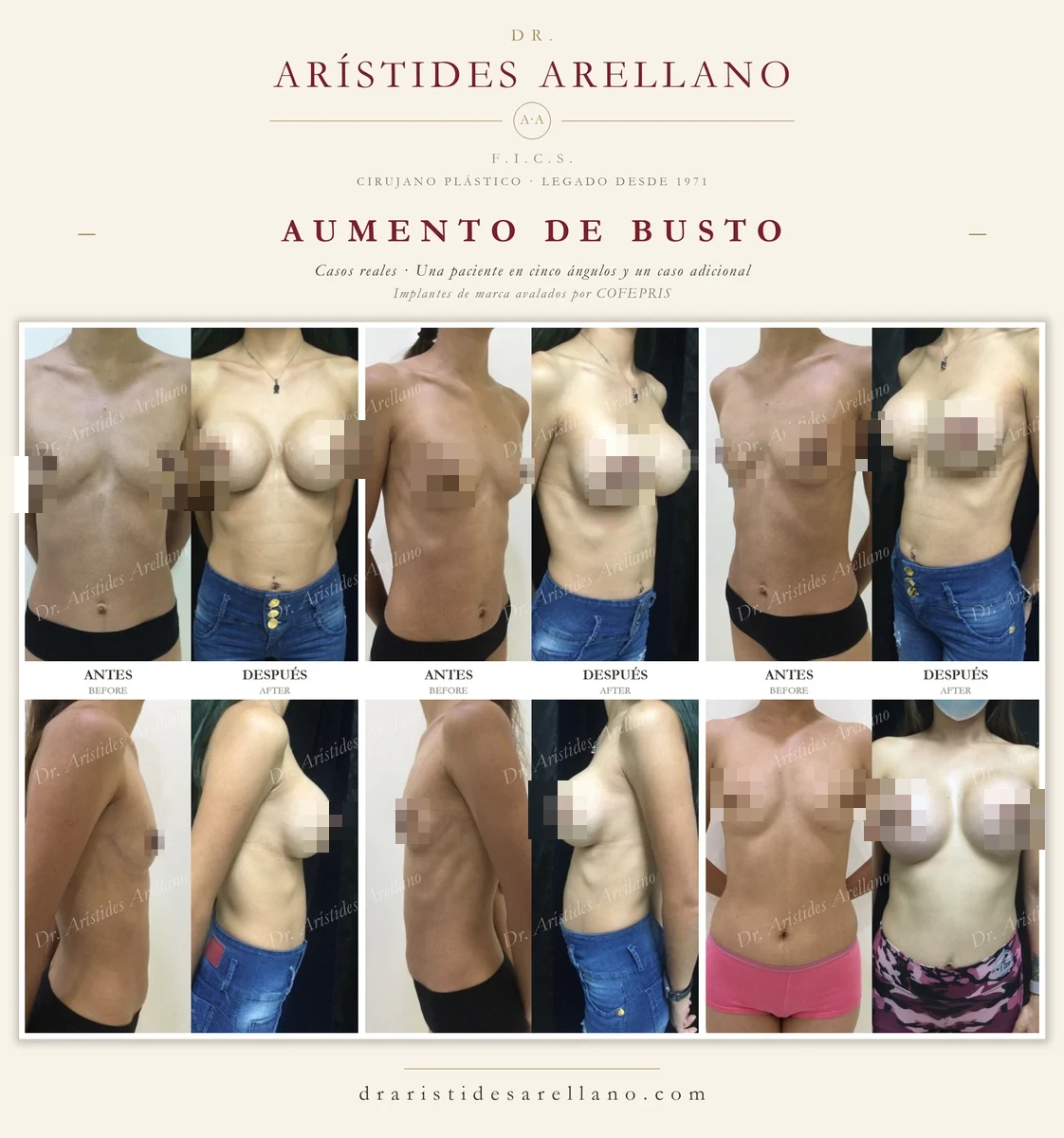
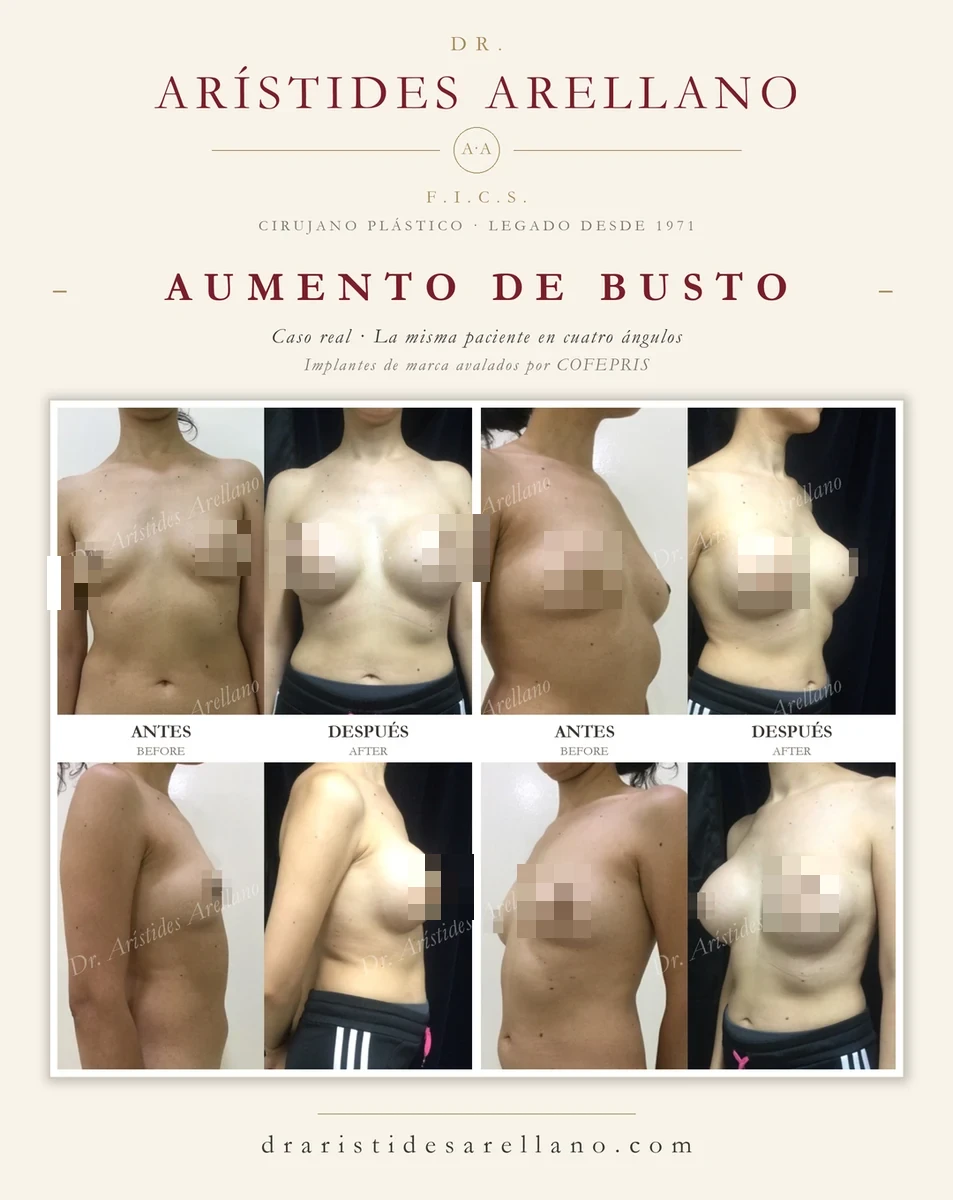
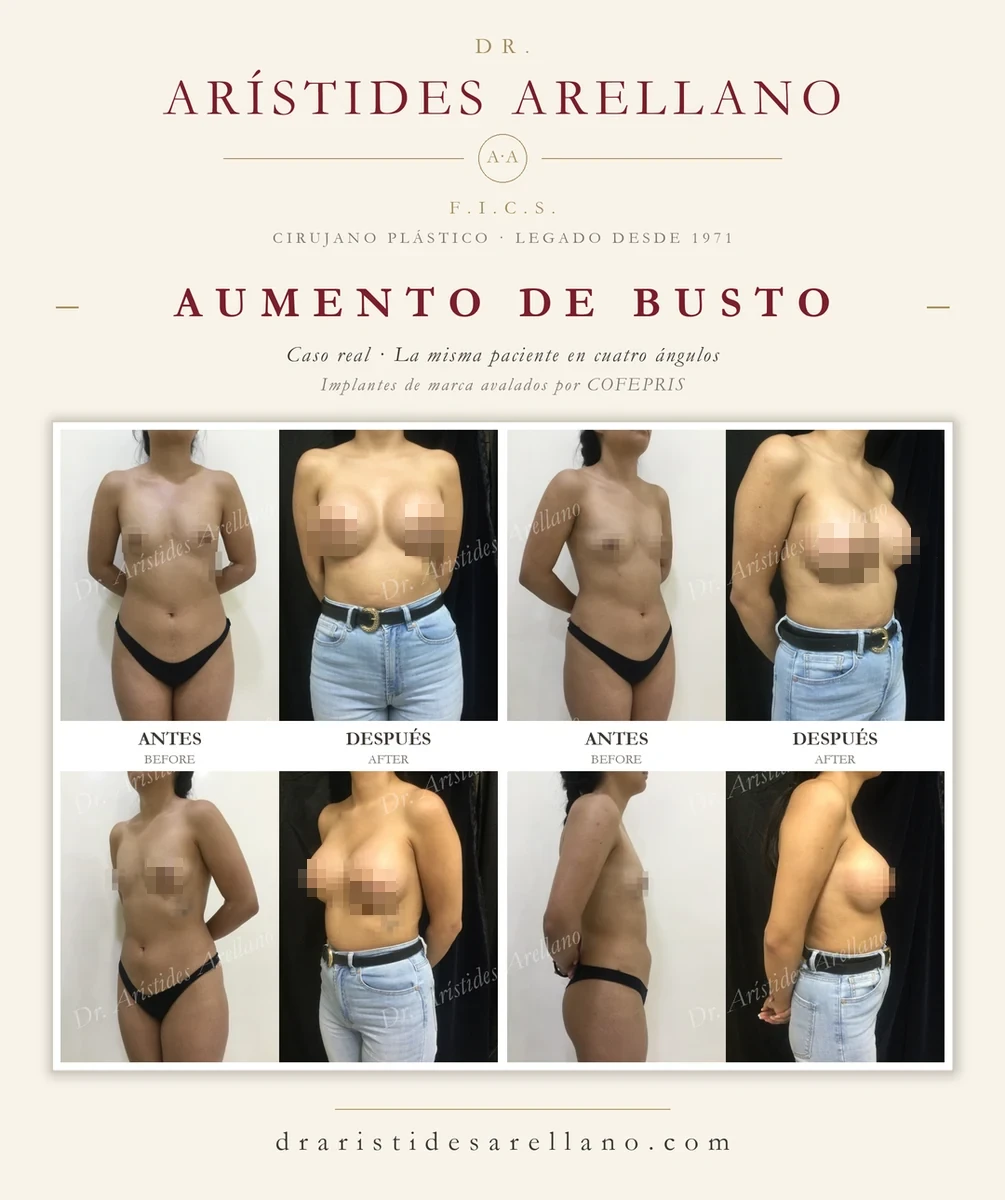
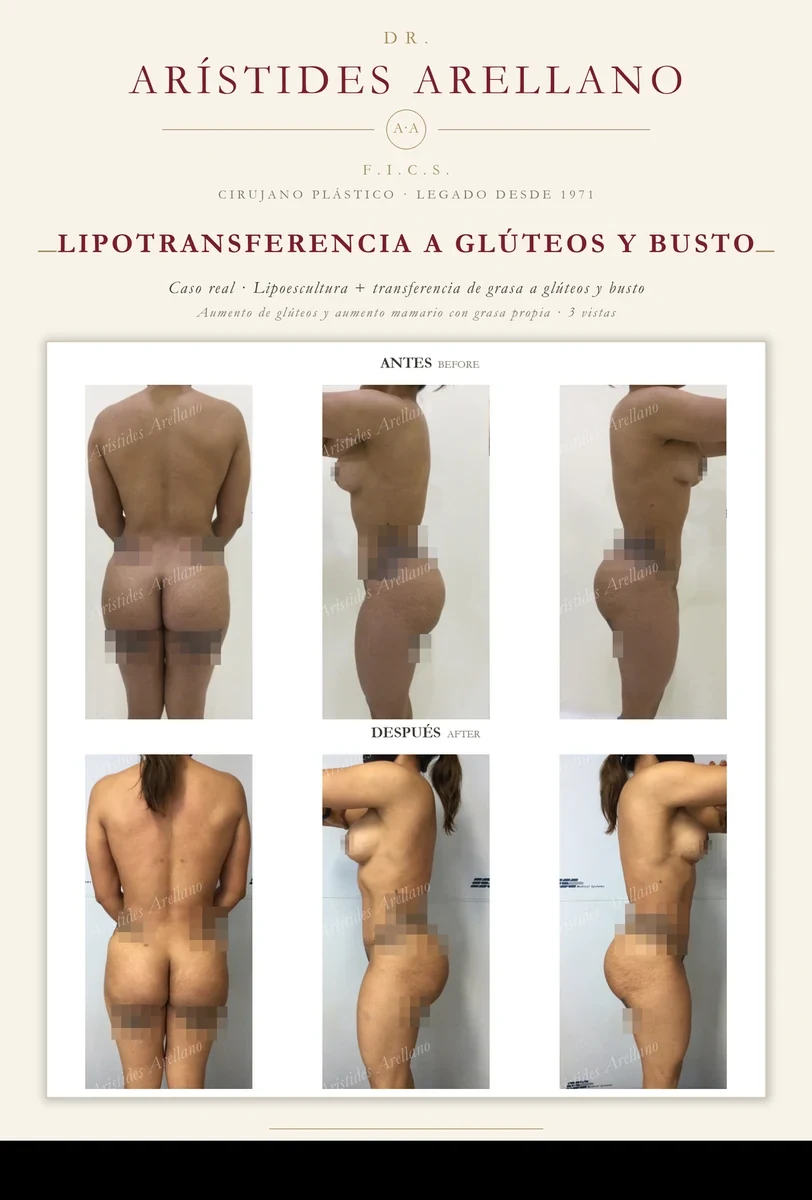
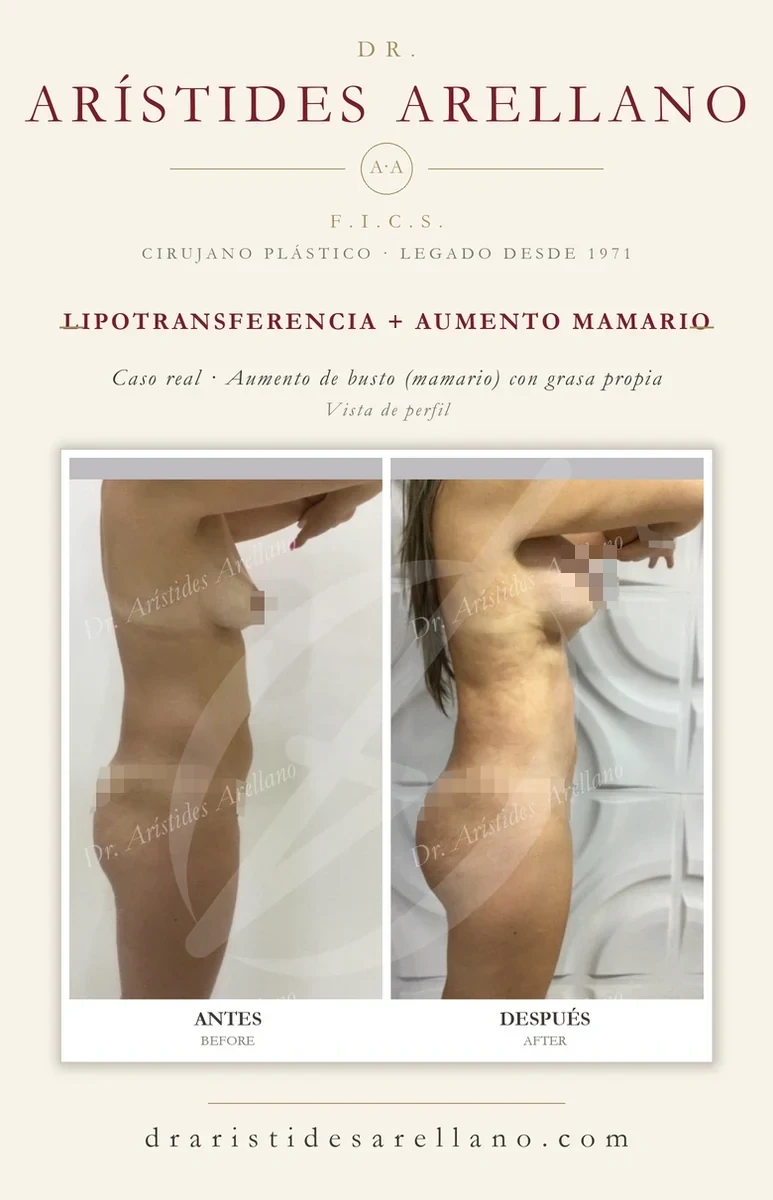
The cases below are real patients of Dr. Arístides Arellano, published with their written informed consent. Out of respect for each person’s privacy, only expressly authorised cases are published; at your in-person consultation Dr. Arístides can show you further cases with a starting point similar to yours. Results may vary from patient to patient.
How much does a breast augmentation cost? It depends on your case
The cost of a breast augmentation is not a single figure: it depends above all on the brand and type of implant chosen, the technique (implants, your own fat, or a combination), the plane and incision route, and whether it is combined with a mastopexy or another procedure. As a reference, augmentation with implants starts at $55,000 MXN, and the lift + implants combination at $60,000 MXN. Approximate price — the definitive cost is set at your private consultation with Dr. Arístides Arellano. The exact quote is defined at your in-person assessment, with the implant and technique you actually need. Here is the full price breakdown: the table for every breast surgery, what the figure includes, what it does not, and what makes a case more expensive.
About Dr. Arístides Arellano
Dr. Arístides Arellano is a plastic surgeon holding a specialty licence: he practises under a Mexican medical licence (D.G.P. 1125959) and a specialty licence in Plastic & Reconstructive Surgery (0002008), both issued by the Directorate General of Professions (DGP), which reissued his certificate of professional standing in 2025. His career began before Mexico’s present-day specialty-board system existed: he belongs to the founding generation of plastic surgery in Puebla, the second generation of a surgical tradition started in 1971 by Dr. Francisco Arellano Ocampo. Trust is verified, not promised: both licences are public and anyone can look them up in the DGP’s National Registry of Professionals.
Related patient guide
To go deeper before or after your consultation: How long do breast implants last? The 10-year myth — part of the informational guide series reviewed by Dr. Arístides Arellano.
And a late complication about which almost no information exists when it happens: milk discharge after breast augmentation — what galactorrhoea is and what to do. It is uncommon, almost always benign and self-resolving, but there are causes unrelated to the surgery that must be ruled out.
The CO₂ laser incision in breast augmentation
In Dr. Arístides Arellano’s breast augmentation, the cut is made with a CO₂ laser. The skin incision — inframammary or periareolar, depending on the route chosen at your assessment — is made with the NovaPulse (Lumenis · Luxar), a focused-beam surgical CO₂ that replaces the cold scalpel in that step. It is worth understanding what changes and what does not: it changes how the skin is opened — not the implant, not the plane, and not the result being sought.
CO₂ emits at 10,600 nm, a wavelength that tissue water absorbs almost completely. It therefore cuts in a very thin layer and seals the finest vessels as it goes: it incises and coagulates in the same pass. On the edge of an incision that will later be the only visible trace of the surgery, that means a drier field during the procedure and a clean wound edge for closure — the same scar the surgical package later follows with laser sessions until it matures.
What the laser does NOT do: it does not create the implant pocket — dissection of the subglandular or submuscular plane is performed with conventional surgical technique —, it does not turn augmentation into a non-surgical procedure, it does not avoid general anaesthesia or sutures, and it does not decide the implant brand or profile. It is also not the same device as the fractional AcuPulse, which renews the skin surface instead of cutting it. It remains major surgery and requires a prior assessment.
Documented training in breast surgery
The implant is the object; the surgery is the plane, the pocket and the symmetry. Dr. Arístides Arellano is a specialist in Plastic & Reconstructive Surgery authorised by the DGP since 1990, and his breast-surgery training begins in his postgraduate years, not at a weekend course:
- International symposium on reconstructive breast surgery — Pontificia Universidad Católica Argentina · Buenos Aires, 7 de mayo de 1988
- Diploma — free papers: periareolar mastopexy — Sociedad de Cirugía Endoscópica del Hospital Betania · Puebla
- Postgraduate diploma in Plastic Surgery (Argentina) — Hospital General de Agudos Dr. Abel Zubizarreta, Municipalidad de Buenos Aires · diciembre de 1989
- DGP specialty authorization — AE-002008 — Dirección General de Profesiones (DGP) · México D.F., 27 de marzo de 1990
Trust is verified, not promised. All 210 scanned documents —degree, licences, diplomas, publications and certificates, from 1977 to 2025— are open in Dr. Arístides Arellano’s credential archive, alongside an explanation of the difference between a specialty licence and a board certification.
Implant brands we use
Every implant Dr. Arístides places is brand-name, COFEPRIS-approved and backed by a manufacturer warranty. Tap each brand to see its shapes, surfaces and gel types.
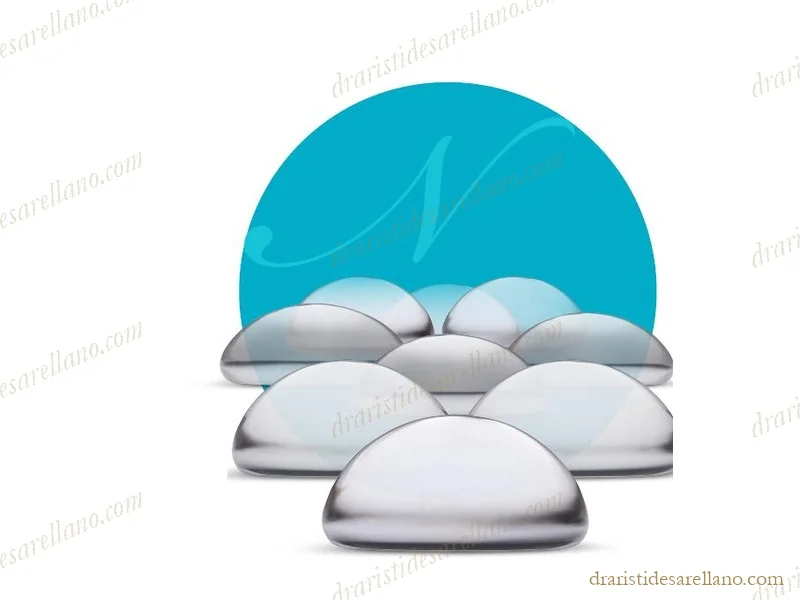 Natrelle® Allergan Aesthetics (AbbVie) The widest range of sizes and projections, with three gel types. View details +
- Round INSPIRA® collection, one of the widest ranges of sizes and projections on the market.
- Three gel cohesivity levels: Responsive, SoftTouch and Highly Cohesive — from softer feel to more defined shape.
- Low, moderate, high and extra-high profiles to match projection to your chest.
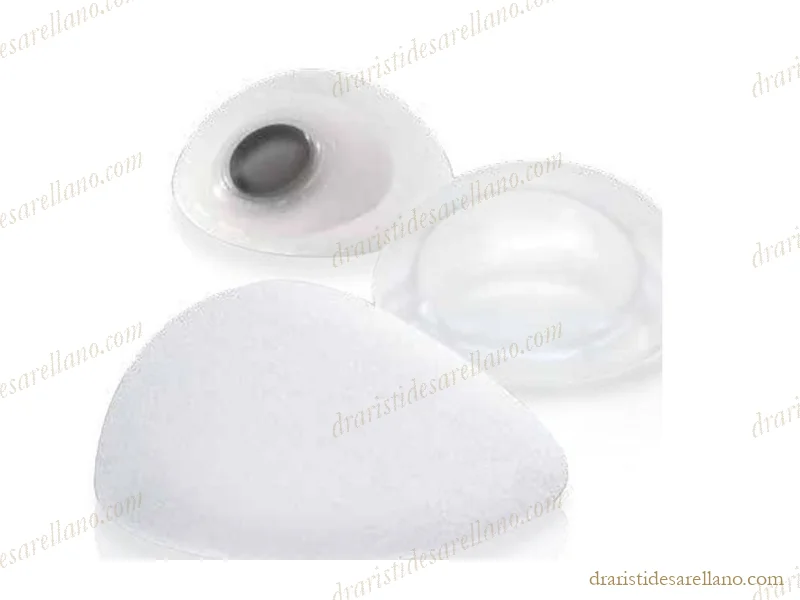 Mentor® Johnson & Johnson MedTech Cohesive MemoryGel® with a natural feel; round and anatomical. View details +
- Cohesive MemoryGel® with a feel that mimics breast tissue.
- Smooth and SILTEX® textured surfaces; round and anatomical (teardrop) MemoryShape® forms.
- Moderate, moderate-plus, high and XTRA profiles for different projection needs.
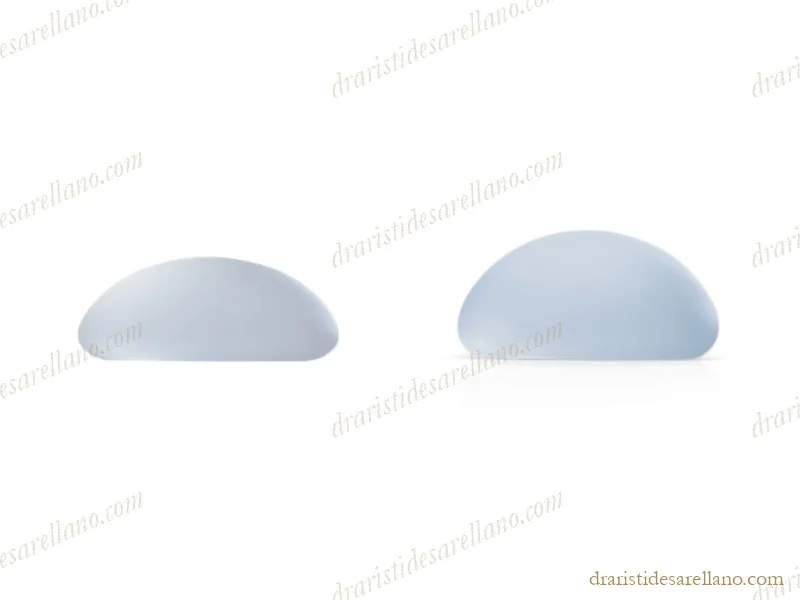 Motiva® Establishment Labs Nanotextured SmoothSilk® surface and posture-adaptive gel. View details +
- Nanotextured SmoothSilk® / SilkSurface® shell, designed to reduce friction with tissue.
- Round and Ergonomix®: ProgressiveGel® adapts to posture — teardrop projection standing, rounder lying down.
- TrueMonobloc® shell and optional Qid® microtransponder to identify the implant without surgery.
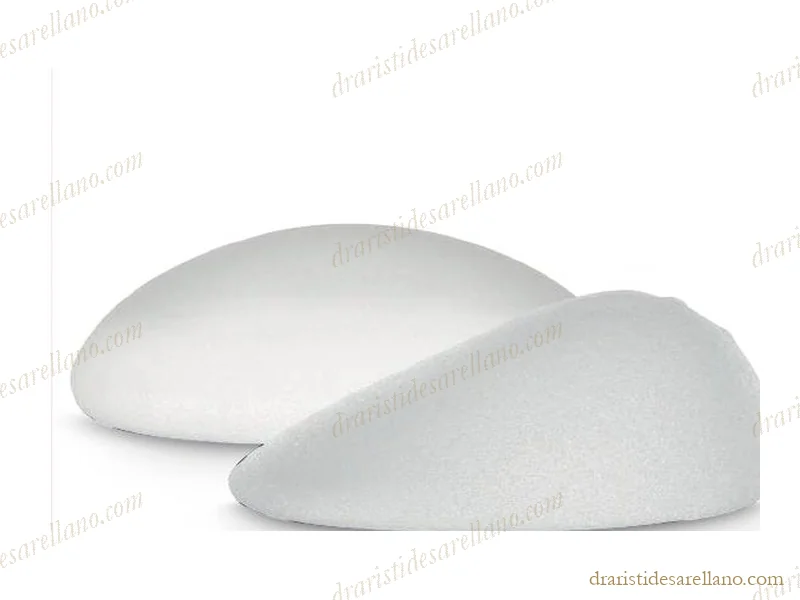 Nagor® / Eurosilicone® GC Aesthetics European tradition: 30+ years manufacturing implants. View details +
- Two European houses with 30+ years manufacturing implants: Round Collection® (Eurosilicone) and IMPLEO™ (Nagor).
- Smooth and textured (Nagotex®) surfaces; round and anatomical shapes.
- SiloGard® / Paragard 360° barrier layer that minimizes gel diffusion.
Brand, size (cc), profile and surface are chosen with you at the consultation, according to your anatomy and goals. Images from each manufacturer’s product material; trademarks belong to their owners.
Dr. Arístides explains it
Informational video by Dr. Arístides Arellano. Every case is different: the details of your procedure are defined at your consultation.
Recovery · step by step
- Days 1–3Swelling, tenderness and a post-surgical bra or garment depending on technique; relative rest with limited arm mobility.
- Weeks 1–2Discomfort decreases; sutures removed where applicable; desk work can resume as medically advised.
- Weeks 3–4Marked improvement in swelling; high-impact or upper-body exercise still discouraged.
- Weeks 6–8Full return to exercise, including chest training, is generally authorised according to individual progress.
- Months 3–6Implants settle into their definitive position and the shape fully stabilises.
Risks and contraindications
Breast augmentation adds together two groups of risks: those of any surgery, and those specific to the implant as a medical device. An informed decision covers both:
- Capsular contracture: the body always forms a tissue capsule around an implant; when that capsule hardens and tightens it can distort the breast or cause discomfort, and advanced grades require revision surgery. It is the most relevant late complication of breast augmentation.
- Implant rupture or wear: implants are not lifetime devices. A rupture can be silent — detectable only on imaging — and is usually managed with replacement.
- Nipple sensitivity changes: increased or decreased, usually temporary; in some cases persistent.
- Implant malposition or rotation: the implant can shift out of its pocket and require surgical revision.
- Rippling: visible or palpable implant folds, more frequent in patients with thin tissue coverage.
- Hematoma and seroma: early, in the first days. A late seroma — fluid appearing months or years later — is always investigated.
- Infection: uncommon; in some cases it requires removing the implant temporarily until the process resolves.
- BIA-ALCL (breast implant–associated anaplastic large cell lymphoma): a rare disease associated mainly with textured-surface implants, usually presenting as late swelling of one breast. Its existence is the medical reason every late seroma is investigated rather than simply drained.
- Effects on breastfeeding: most patients can breastfeed after augmentation, but the operation can affect milk production in some cases.
- Interference with imaging: mammography requires special views in patients with implants; always tell the imaging centre.
Breast augmentation is postponed or reconsidered in these situations:
- Current pregnancy or breastfeeding: waiting at least six months after finishing breastfeeding is recommended.
- Active breast disease or unresolved findings: any lump or pending imaging result is investigated first.
- Active infection anywhere in the body.
- Clotting disorders or unmanaged chronic disease.
- Expecting a volume the patient’s own tissue cannot safely cover: the size is chosen with the anatomy, not against it.
Frequently asked questions
How much does breast augmentation cost in Puebla?
The reference price for breast augmentation with implants is approximately $55,000 MXN. The final cost is confirmed at the in-person consultation, as it depends on the implant type, the incision route and whether it is combined with mastopexy.
Which implant brand does Dr. Arístides Arellano use?
Dr. Arístides uses only brand-name, medical-grade, COFEPRIS-approved implants from the world’s leading manufacturers, such as Allergan Natrelle®, Mentor® (Johnson & Johnson), Motiva® (Establishment Labs) and Nagor® / Eurosilicone® (GC Aesthetics). The brand and model are chosen according to your anatomy and goals at the assessment.
Do breast implants have a warranty?
Yes. The brands Dr. Arístides uses back their implants with a 10-year manufacturer warranty, plus additional protection programs. Every implant comes with its card and serial number certifying its origin.
Are the implants approved by COFEPRIS?
Yes. Every implant he uses is registered with COFEPRIS for legal, safe use in Mexico. It is an essential safety requirement: be wary of implants without health-registry approval or of prices far below market.
What types of breast implant are there?
They differ by content (cohesive silicone gel or saline), shape (round or anatomical teardrop), surface (smooth, textured or nanotextured) and profile or projection (low, moderate, high or extra-high). At the assessment the one that best fits your chest and goals is chosen.
Which is better, implants or augmentation with my own fat?
It depends on the goal of each patient. Implants allow a more predictable and larger increase in volume; fat transfer offers a more natural feel and a smaller increase, while also improving the contour of the donor area. Both options are reviewed at consultation according to your anatomy.
Which implant profile is right for me?
Profile (low, moderate or high) determines how much forward projection the implant has. The choice depends on your body type, the amount of native breast tissue and the result you want, and is defined during the assessment with Dr. Arístides.
What is the difference between the submuscular and subglandular plane?
The subglandular plane places the implant beneath the breast gland; the submuscular (or dual plane) places it beneath the pectoral muscle. The choice depends on the amount of native tissue and the desired result, and is defined at the assessment.
Does breast augmentation leave a visible scar?
The scar depends on the incision route used: inframammary, periareolar or transaxillary. They are generally small scars in discreet locations, whose final visibility varies with each patient and their healing process.
Can I combine breast augmentation with a lift?
Yes. When there is drooping (ptosis) in addition to a volume deficit, combining a lift with implants is usually recommended in the same surgery. This is assessed case by case.
Will I be able to breastfeed after breast augmentation?
In most cases yes, especially with approaches that spare the breast gland. It cannot be guaranteed in every case; it is discussed at the assessment according to the technique chosen.
Do implants have to be replaced every 10 years?
There is no fixed rule. Follow-up and control studies are advised; an implant is reviewed or replaced when there is a medical indication, not on an automatic schedule.
Which part of breast augmentation is done with a laser?
The incision: the skin cut is made with a surgical CO₂ laser (NovaPulse), which seals the finest vessels as it cuts and leaves a drier field. The pocket where the implant sits is dissected with conventional surgical technique. The laser changes how the cut is made, not the result of the augmentation; the surgery still requires general anaesthesia and a prior assessment. Results may vary.
Before and after
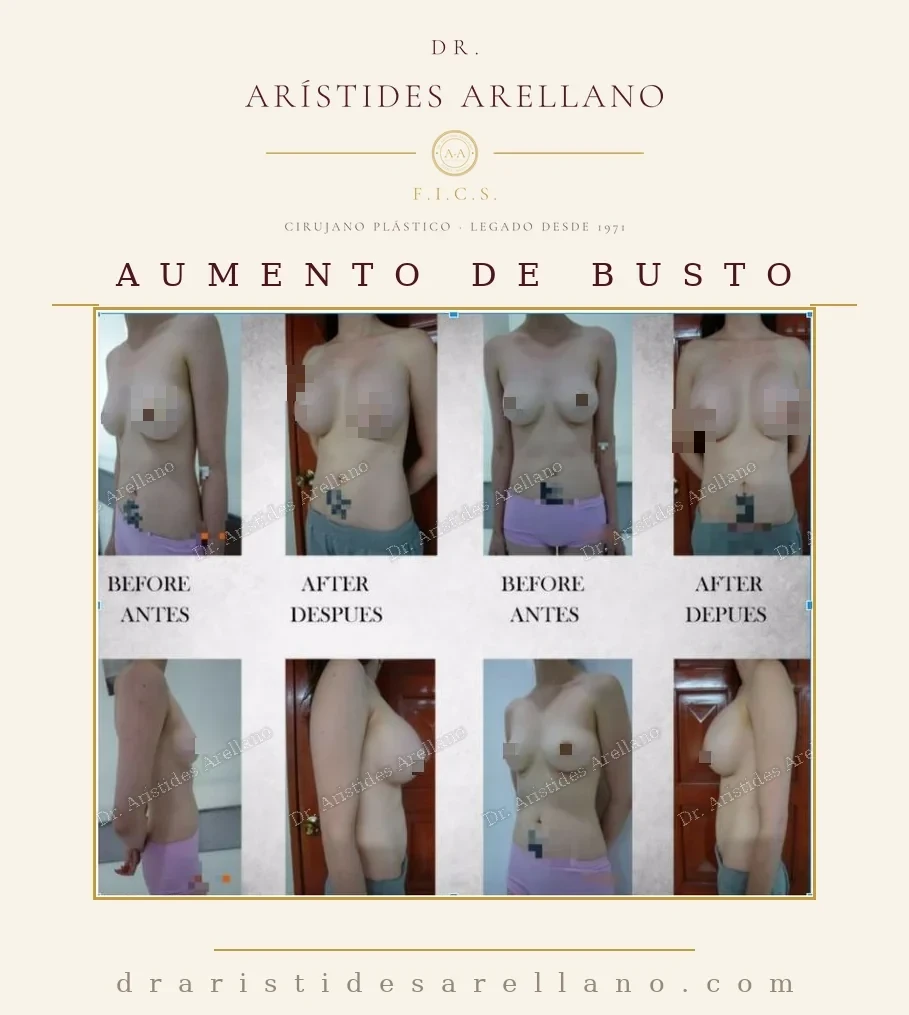
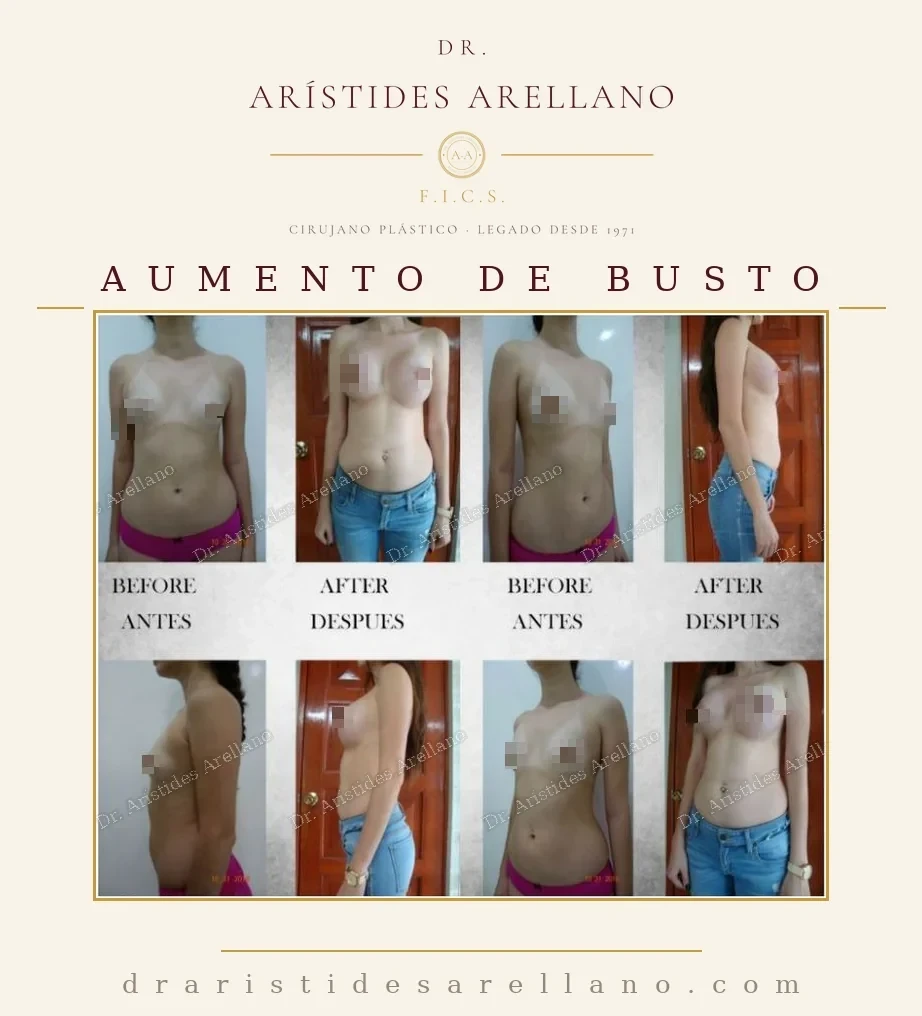
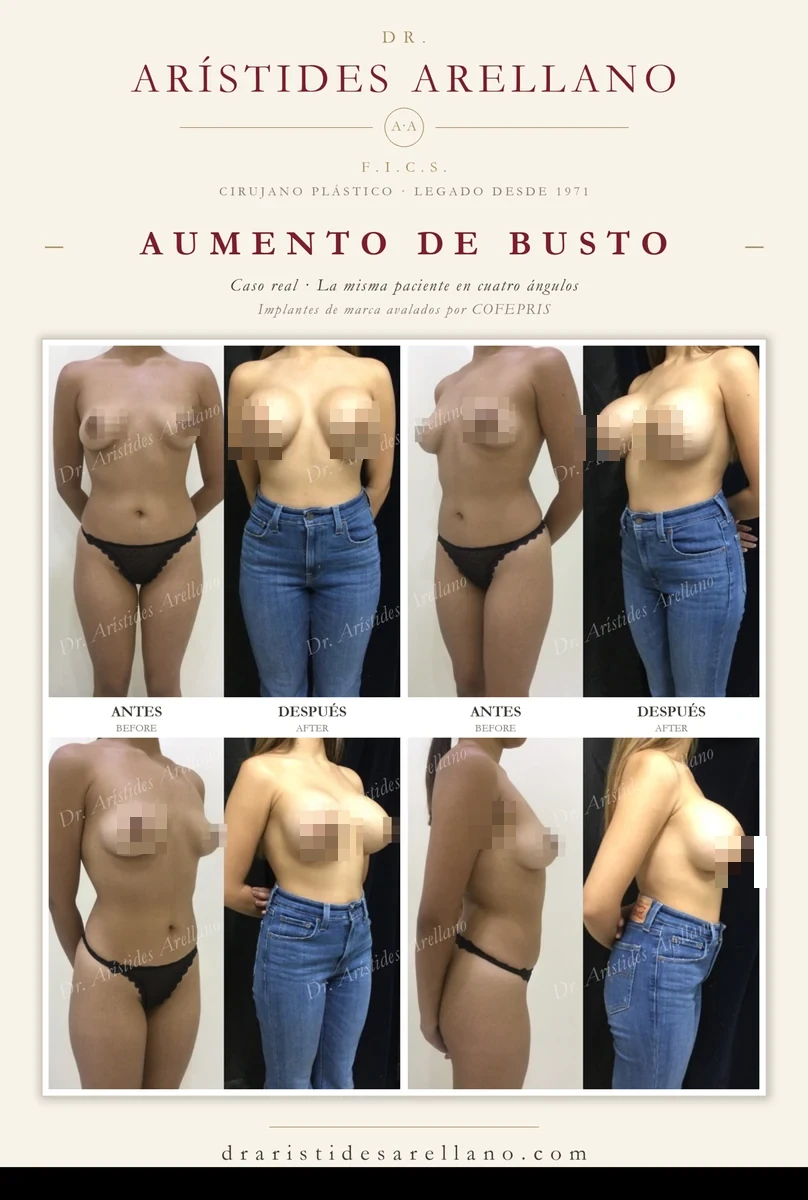
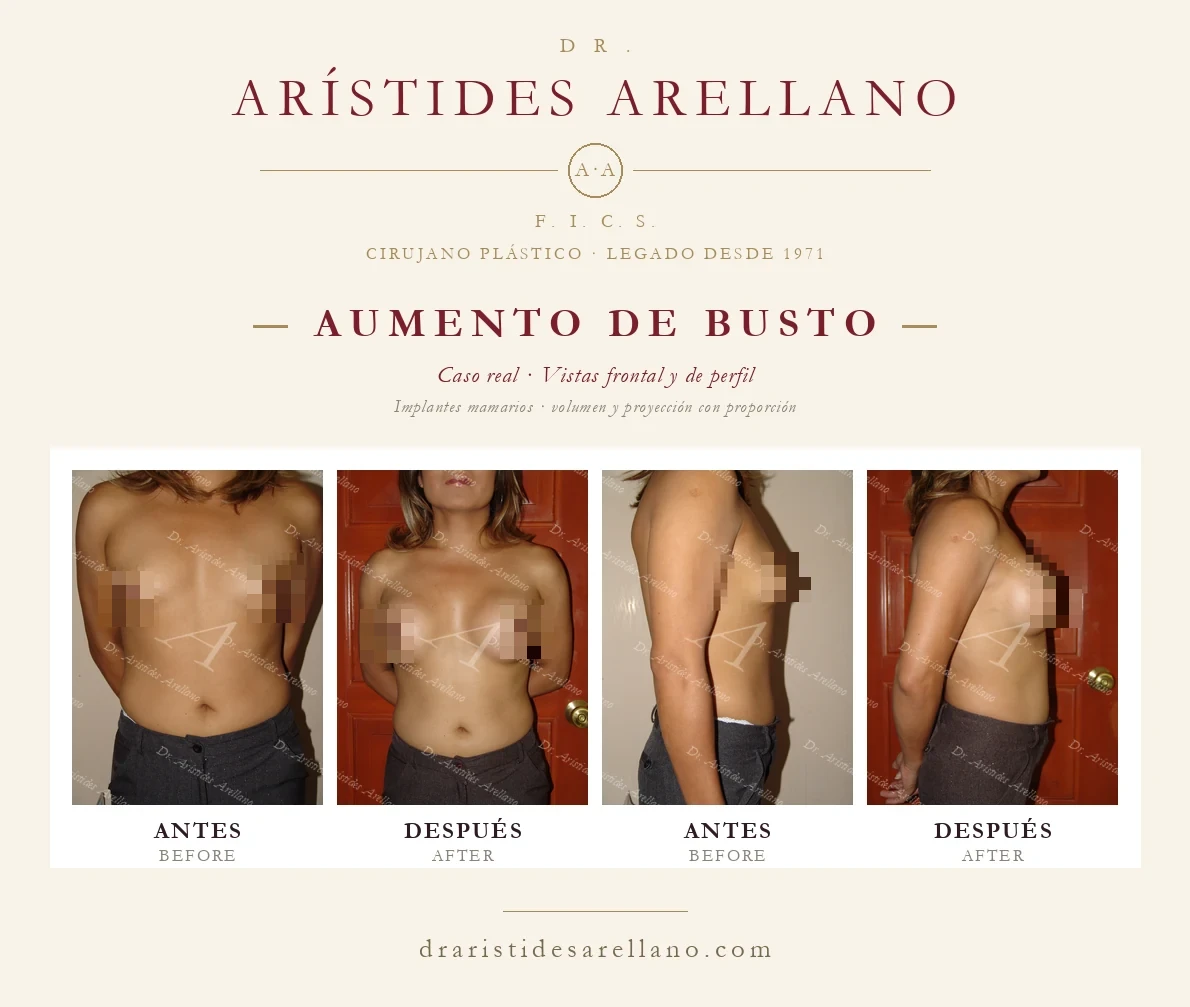
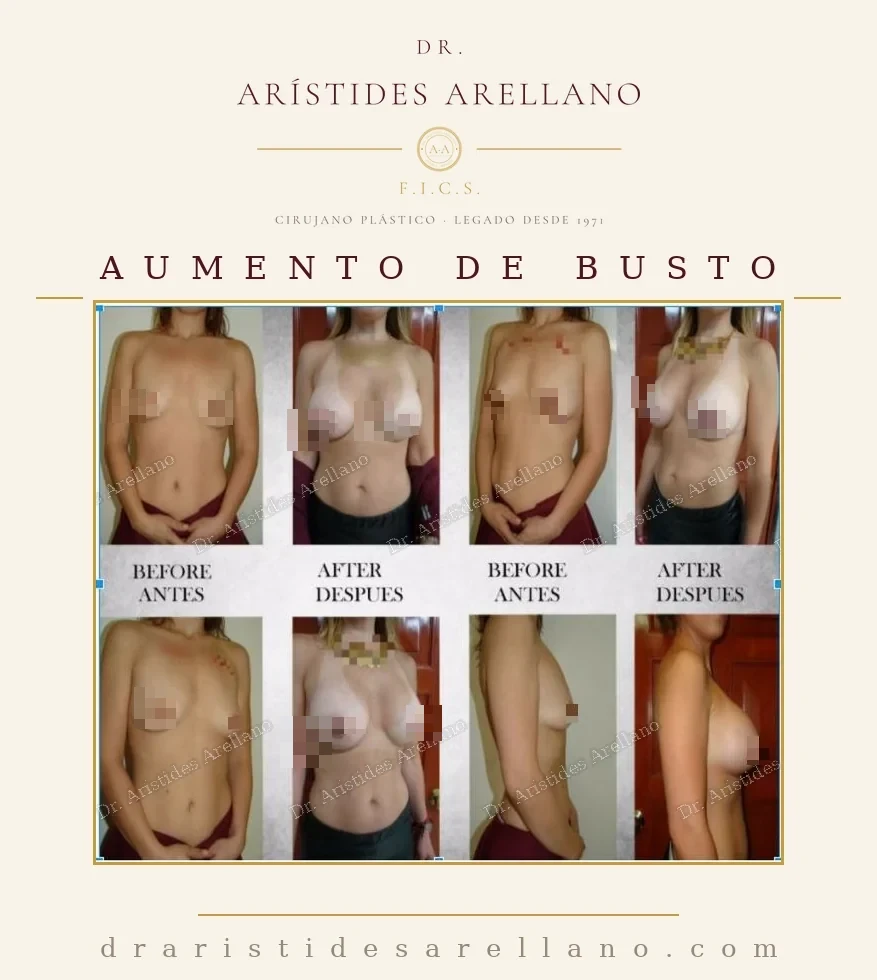
Real case of breast augmentation in Puebla, in frontal and profile views. The profile reveals projection, which a frontal view does not show: that is why a serious assessment always photographs both angles. Implant size is not chosen by cup size but by the width of the breast base and each patient's skin quality. All surgery carries risks and requires a prior medical assessment; results may vary from person to person.
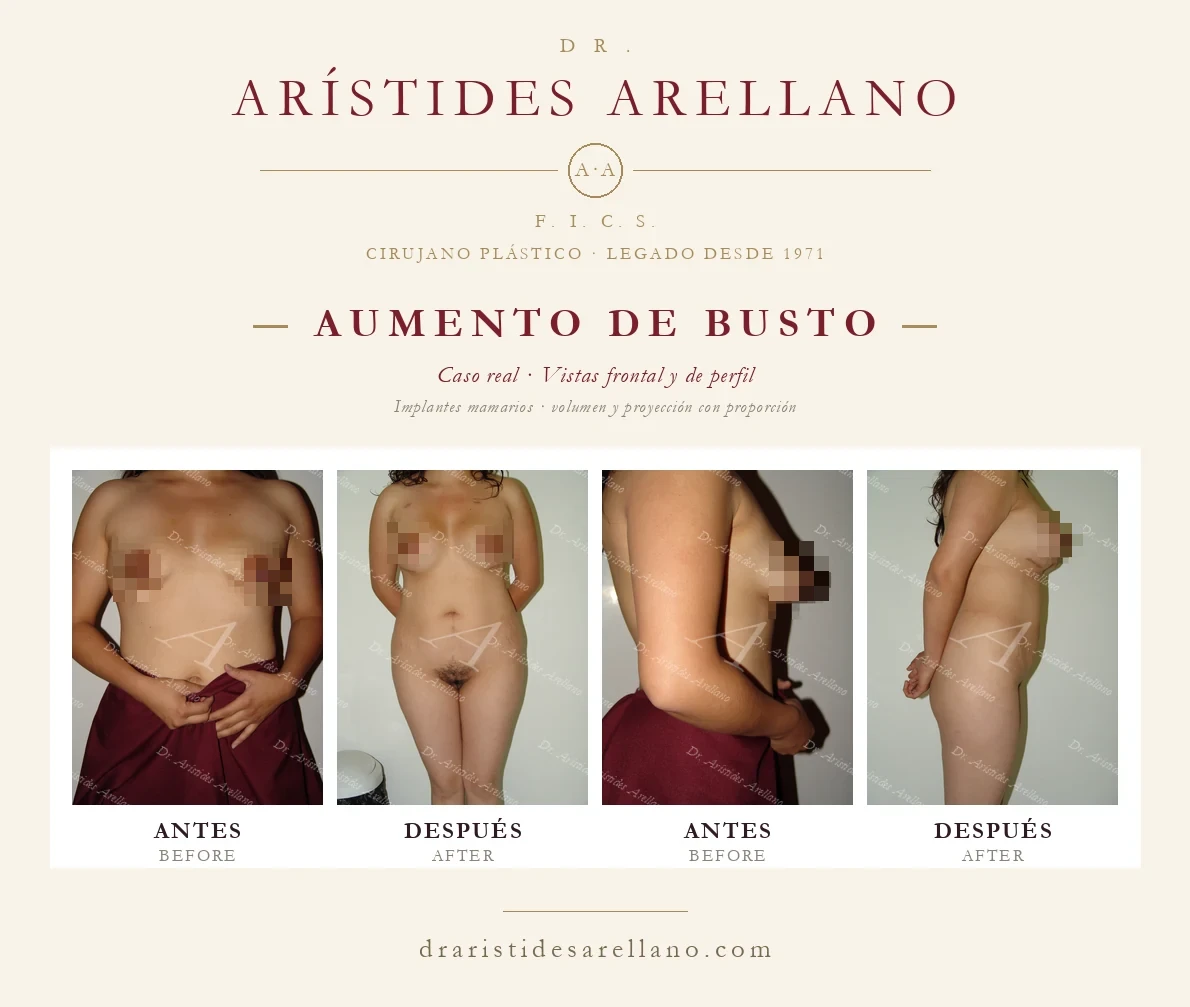
Real case of breast augmentation in Puebla, in frontal and profile views. The goal is proportion with the chest and hips, not the largest possible volume. In this practice the incision is made with a CO₂ laser, which cuts and coagulates at once, reducing bleeding during surgery. All surgery carries risks and requires a prior medical assessment; results may vary from person to person.
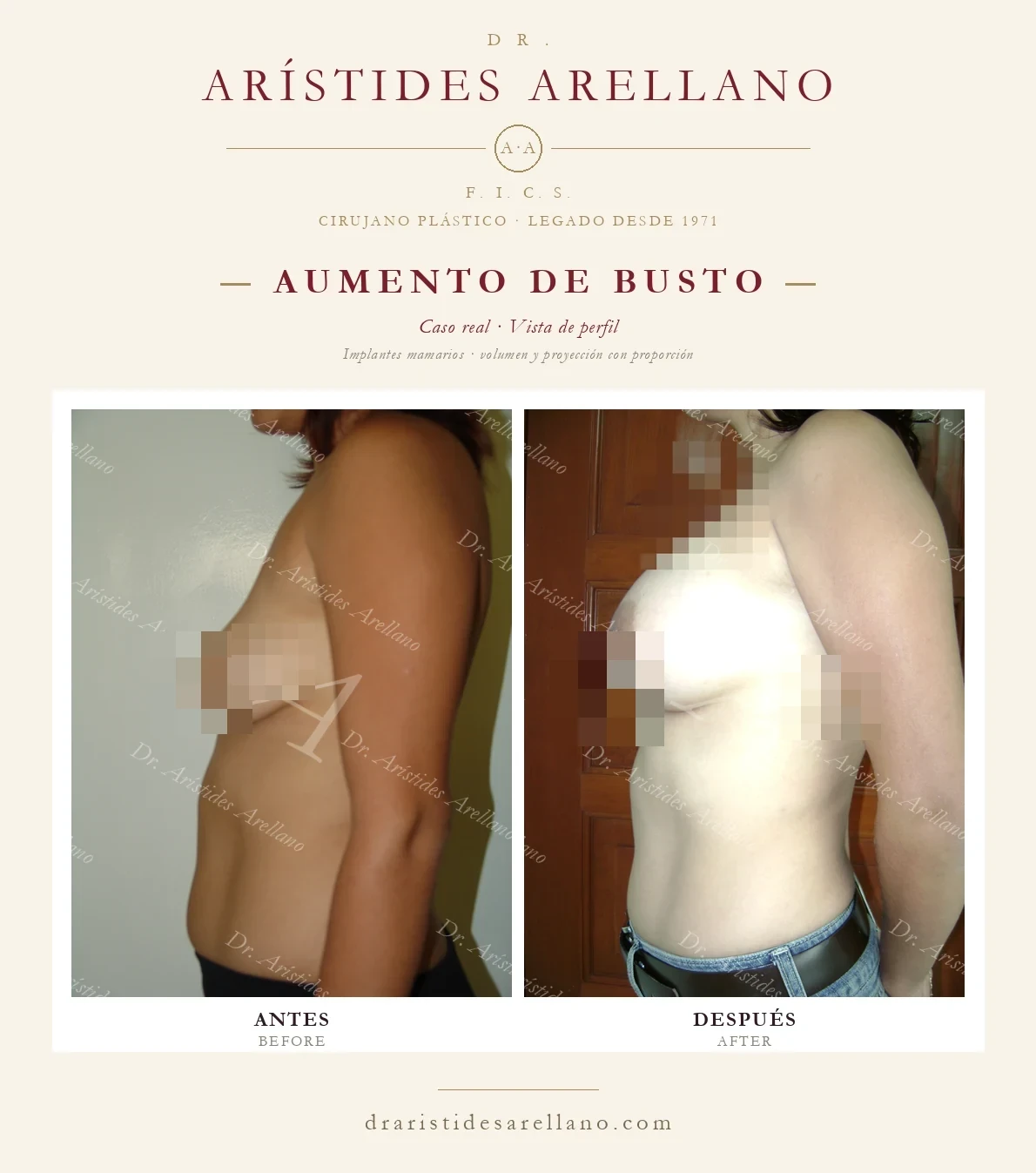
Real case of breast augmentation in Puebla, profile view. The implant is placed in a plane — subglandular, submuscular or dual — chosen at the consultation according to how much of the patient's own tissue covers it; that decision determines whether the result looks natural and whether the implant edge shows. All surgery carries risks and requires a prior medical assessment; results may vary from person to person.
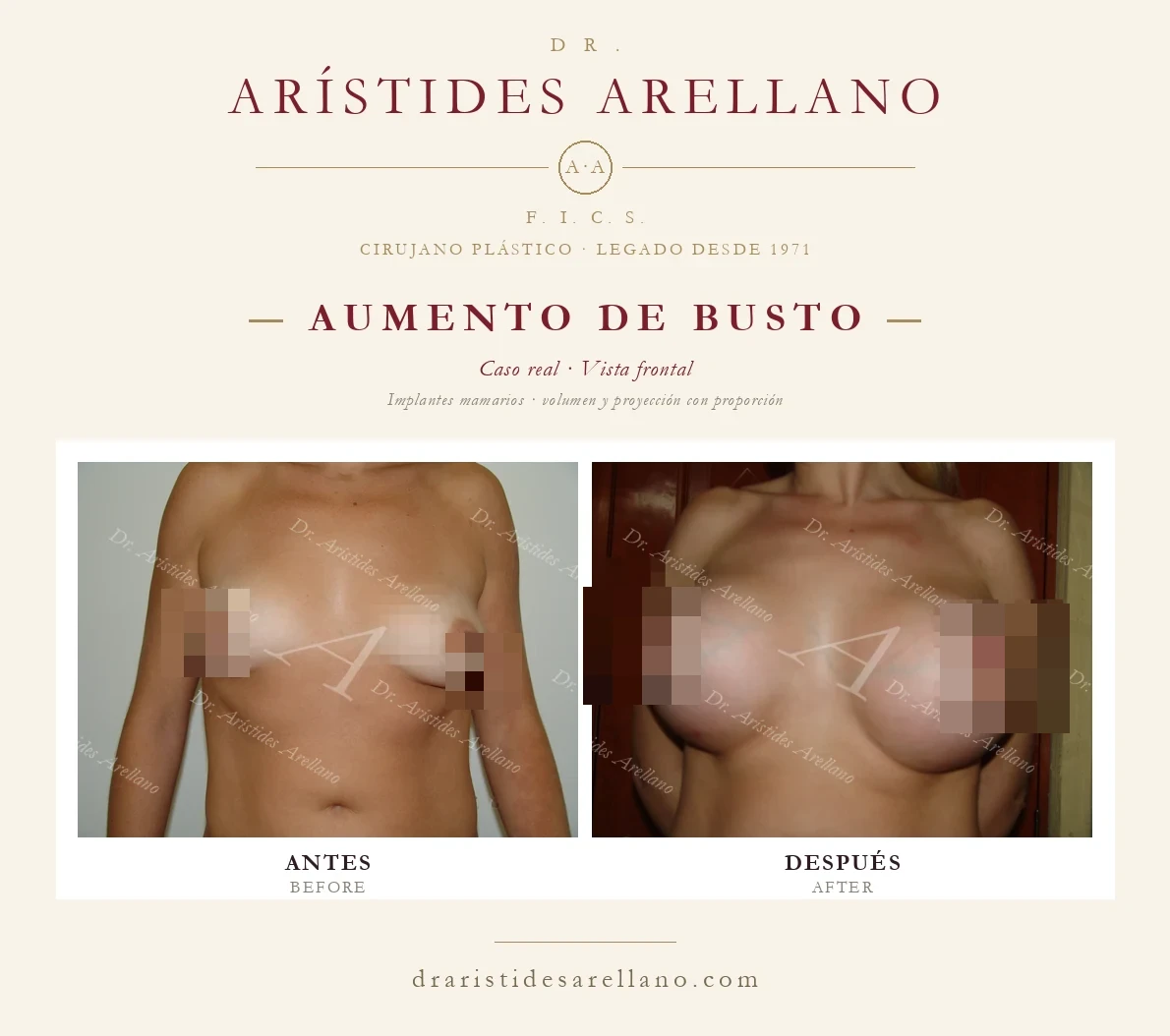
Real case of breast augmentation in Puebla, frontal view. A discreet, proportionate result is a legitimate and common goal: not every patient wants a large change. Pre-existing asymmetry between the breasts is normal and is partly corrected, not always completely. All surgery carries risks and requires a prior medical assessment; results may vary from person to person.
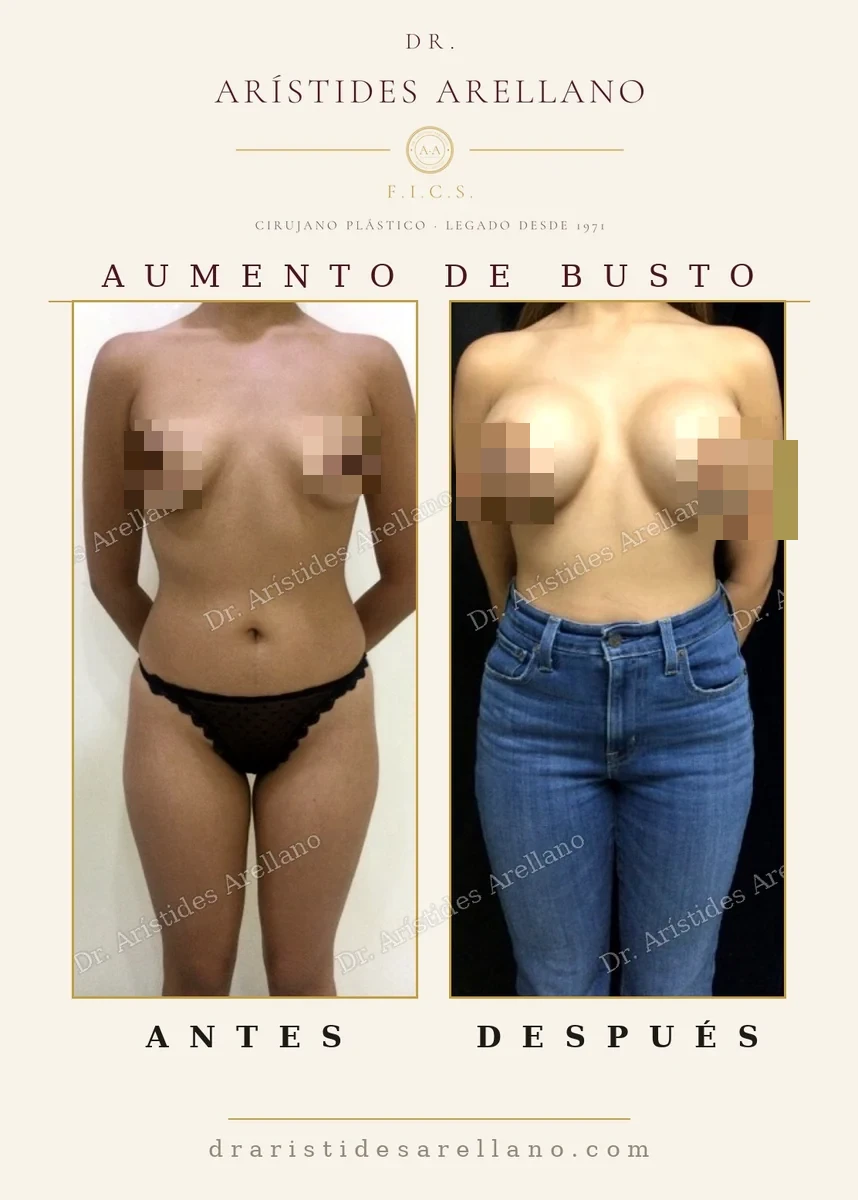
How much do breast implants cost? Here breast augmentation starts at approximately MX$55,000, including theatre, pre-operative laboratory work and post-surgical recovery. COFEPRIS-certified brand implants are inside that price: the implant is not quoted separately to make the opening figure look lower. The definitive cost of each case is set at the private assessment consultation. All surgery carries risks and requires a prior medical assessment; results vary from person to person.
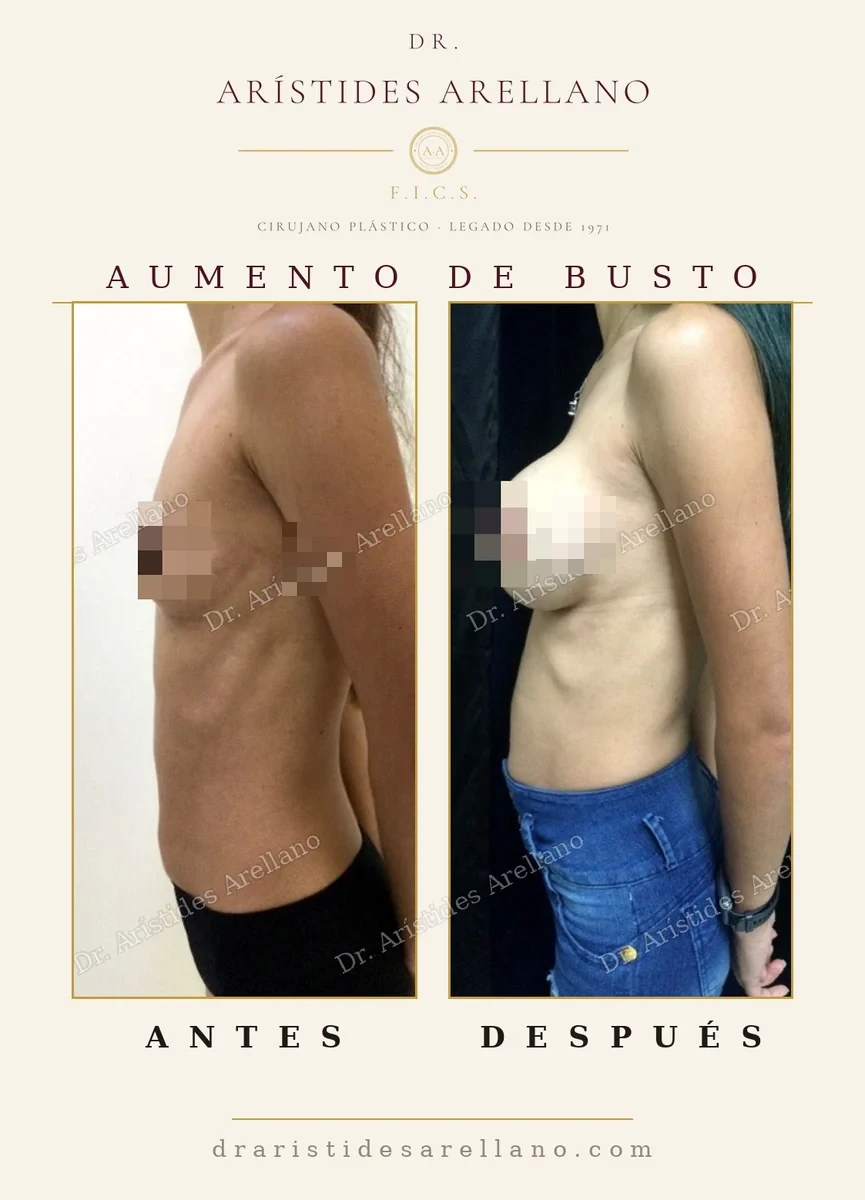
How long do breast implants last? They do not expire at ten years, which is the most repeated myth. Serious brands give a lifetime warranty against rupture, and implants are replaced when there is a reason — rupture, capsular contracture, or the patient wanting a different size — not by calendar. Periodic review is what is actually advisable. All surgery carries risks and requires a prior medical assessment; results vary from person to person.
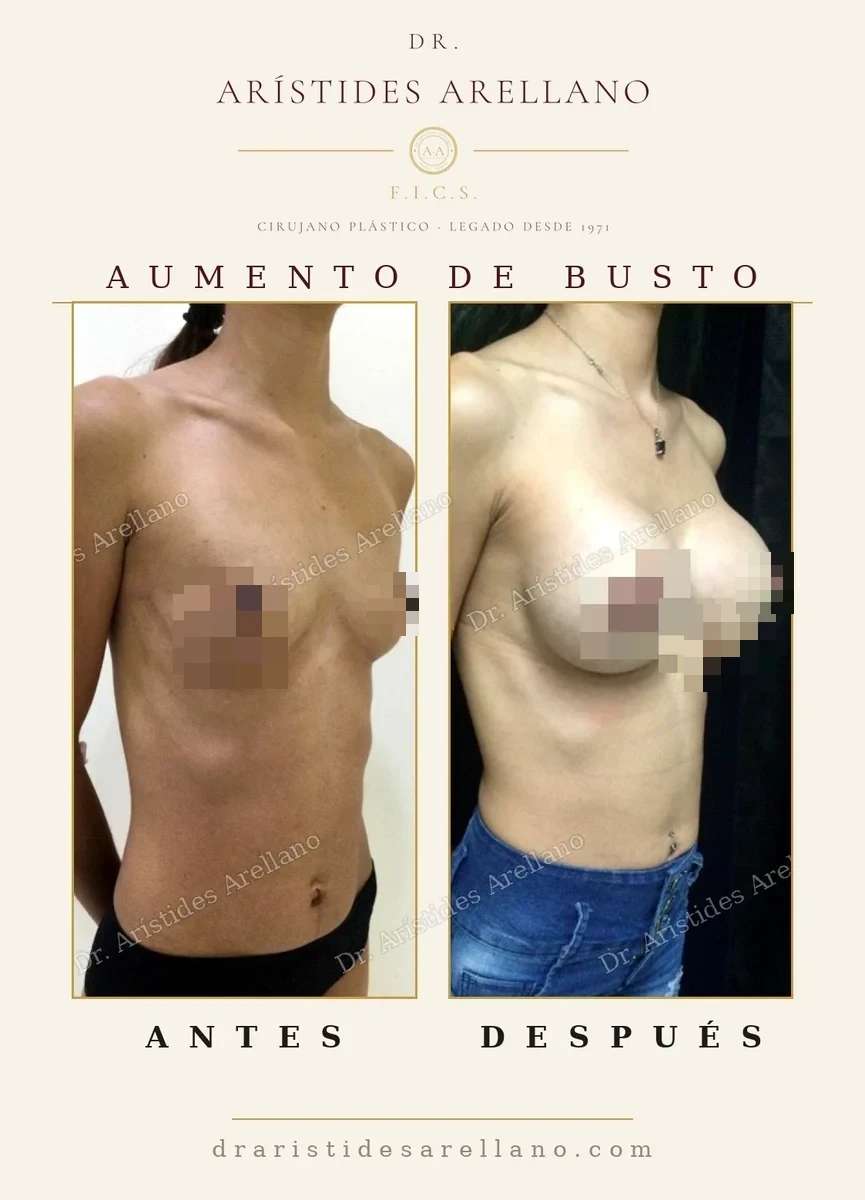
Is recovery from breast augmentation painful? The first 3 to 5 days bring a feeling of tightness, as if the chest were compressed, rather than sharp pain; it is managed with ordinary painkillers. It hurts more when the implant sits behind the muscle. Most patients return to desk work within a week, and to upper-body training around the second month. All surgery carries risks and requires a prior medical assessment; results vary from person to person.
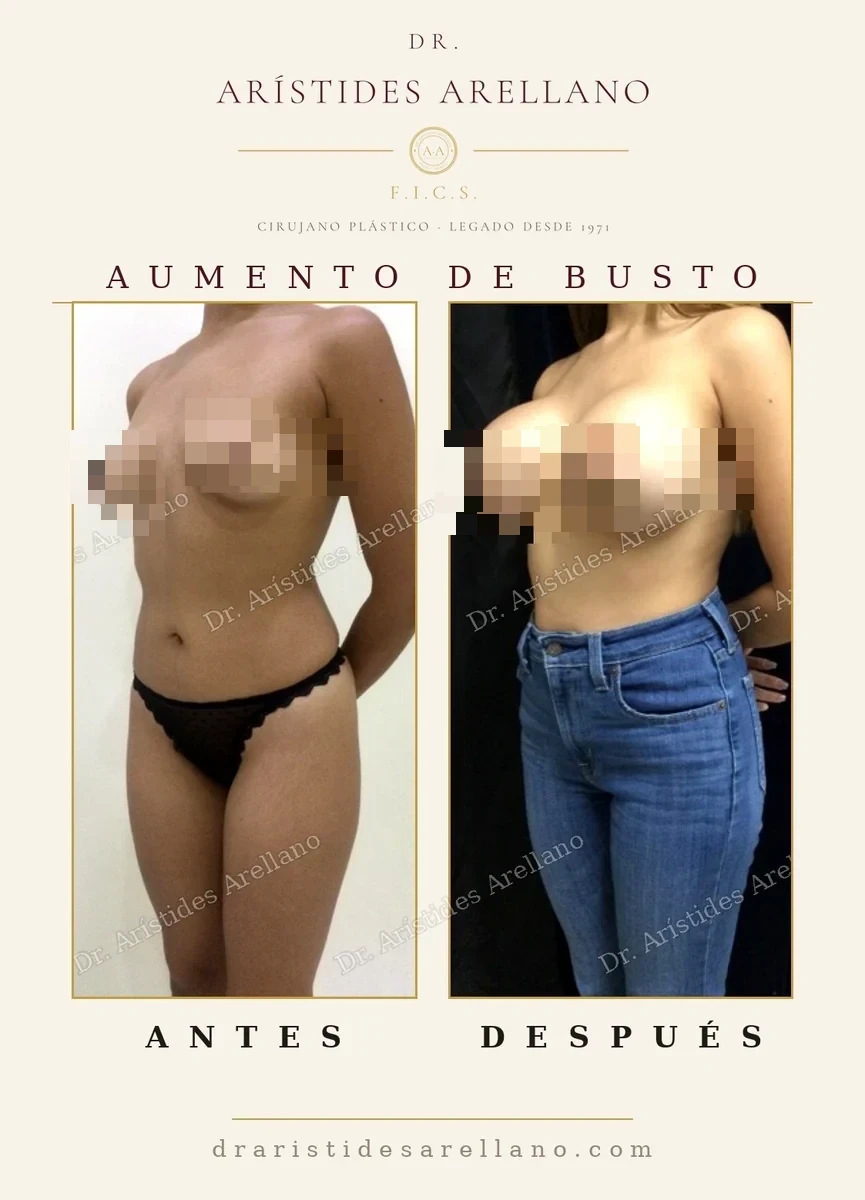
How often do implants need replacing? There is no due date. They are replaced if a medical or aesthetic reason appears, and many patients reach twenty years with the same ones. What does change over time is the surrounding tissue: pregnancy, breastfeeding and weight changes shift the result, not the implant. All surgery carries risks and requires a prior medical assessment; results vary from person to person.
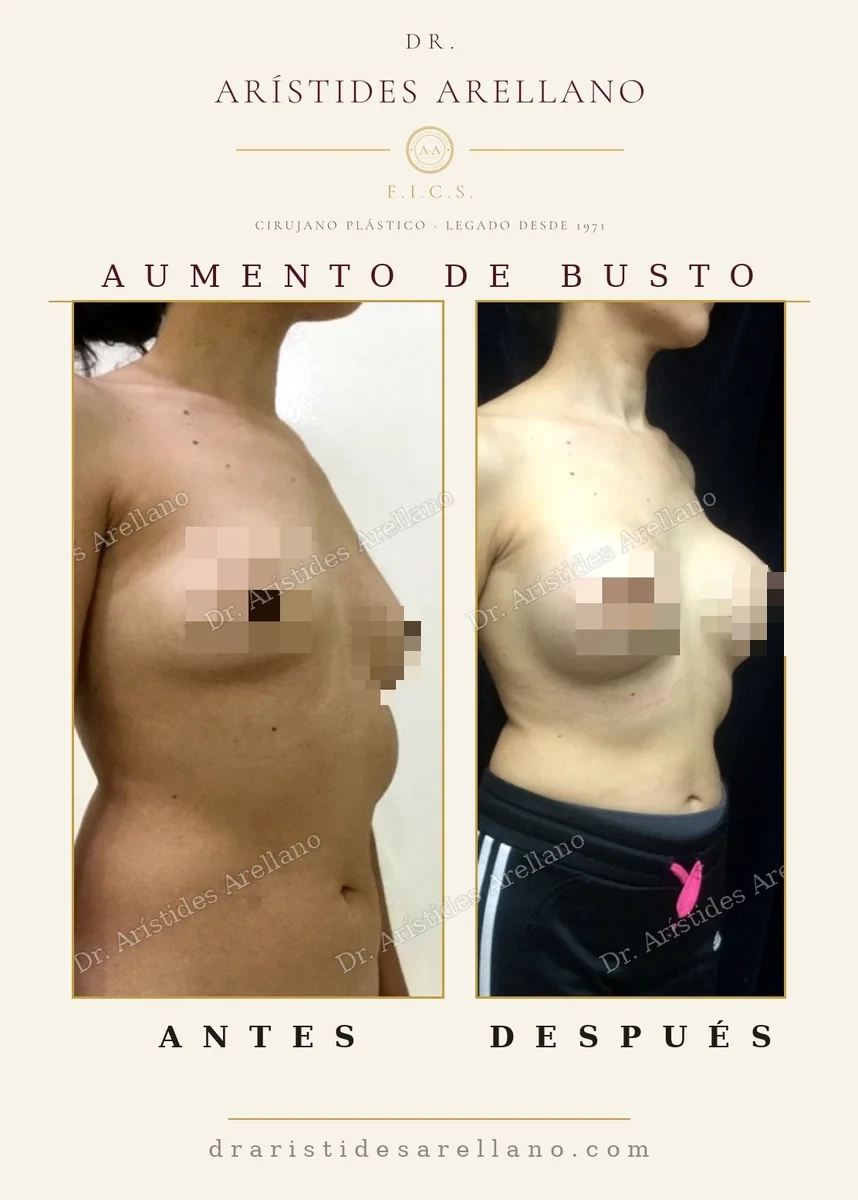
What do implant «cc» mean? Cubic centimetres — the volume the implant occupies, not a bra size. Two hundred cc do not give the same cup size in two different women: it depends on chest width and the tissue already there. That is why size is decided by measuring the breast base, not by picking a number. All surgery carries risks and requires a prior medical assessment; results vary from person to person.
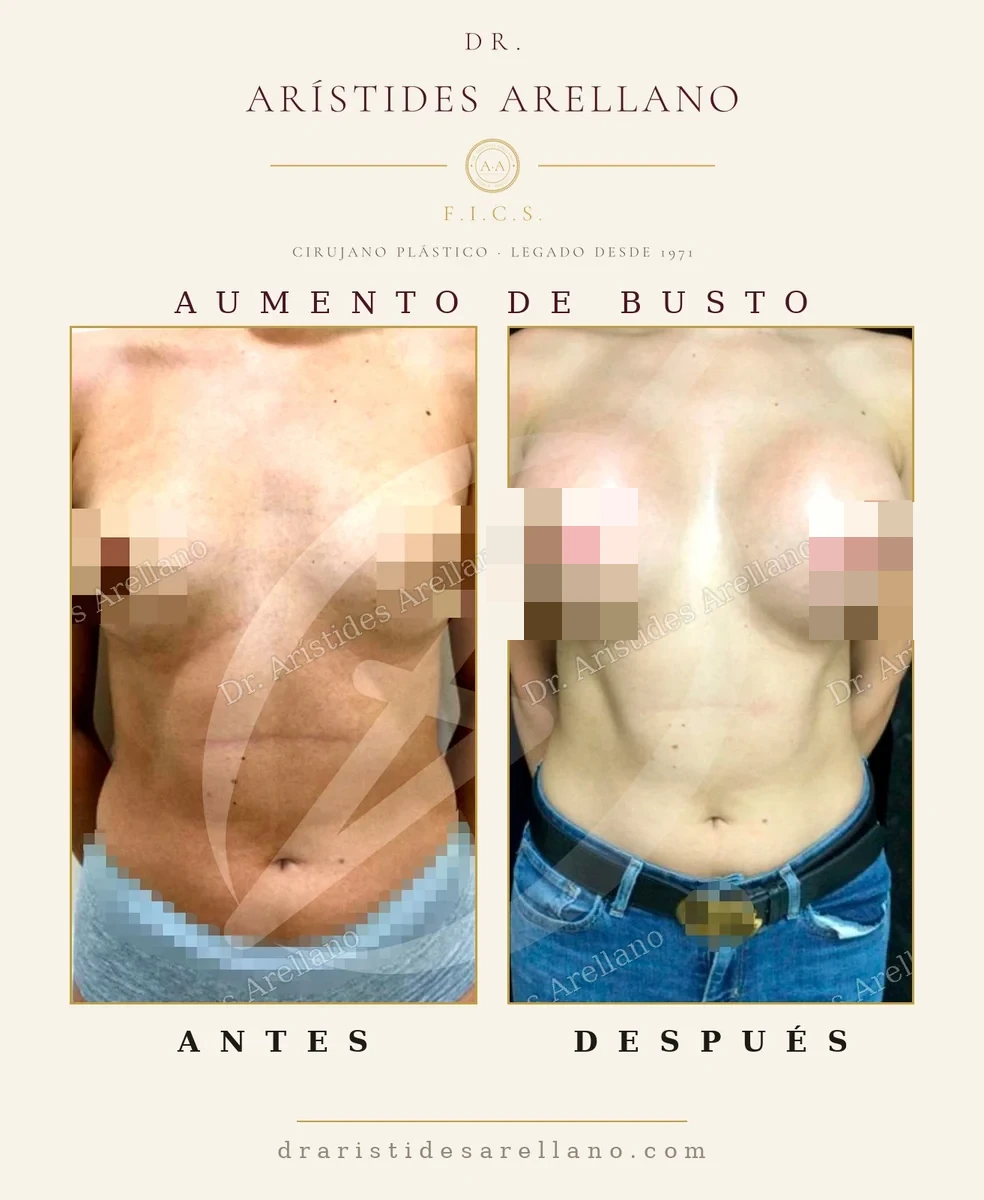
What are breast implants made of? A silicone shell and a filling that today is cohesive gel: a silicone with a gummy-candy consistency that does not leak if the shell ruptures. Saline implants also exist, used less because they are more palpable. Both must carry COFEPRIS health registration. All surgery carries risks and requires a prior medical assessment; results vary from person to person.
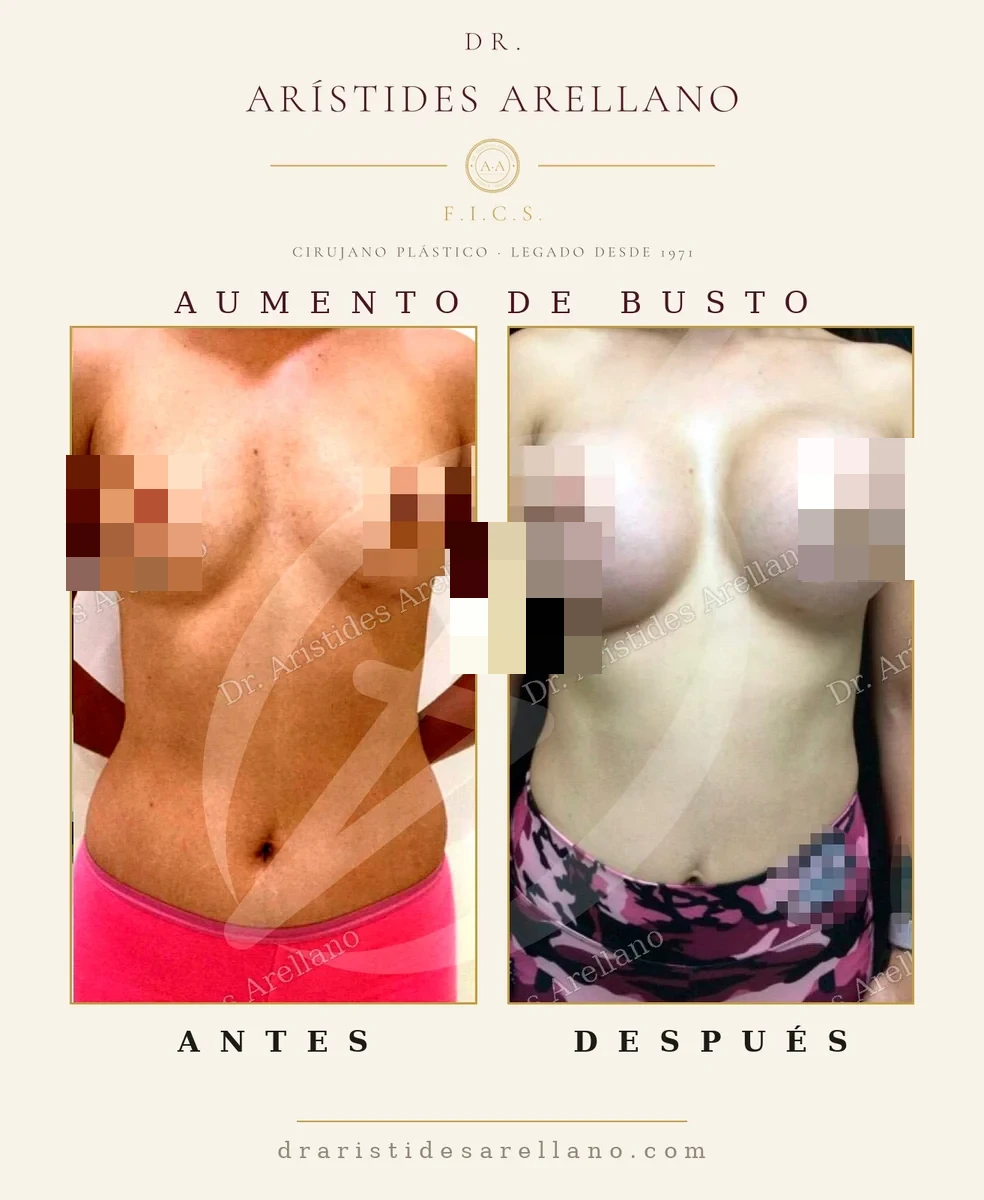
Which implant brand is best? There is no single best for everyone. Brands with a track record and a lifetime warranty — Allergan Natrelle®, Mentor®, Motiva®, Nagor® — are all defensible; what decides it is which shape, profile and volume suit that chest. Be wary of anyone selling you a brand before measuring you. All surgery carries risks and requires a prior medical assessment; results vary from person to person.
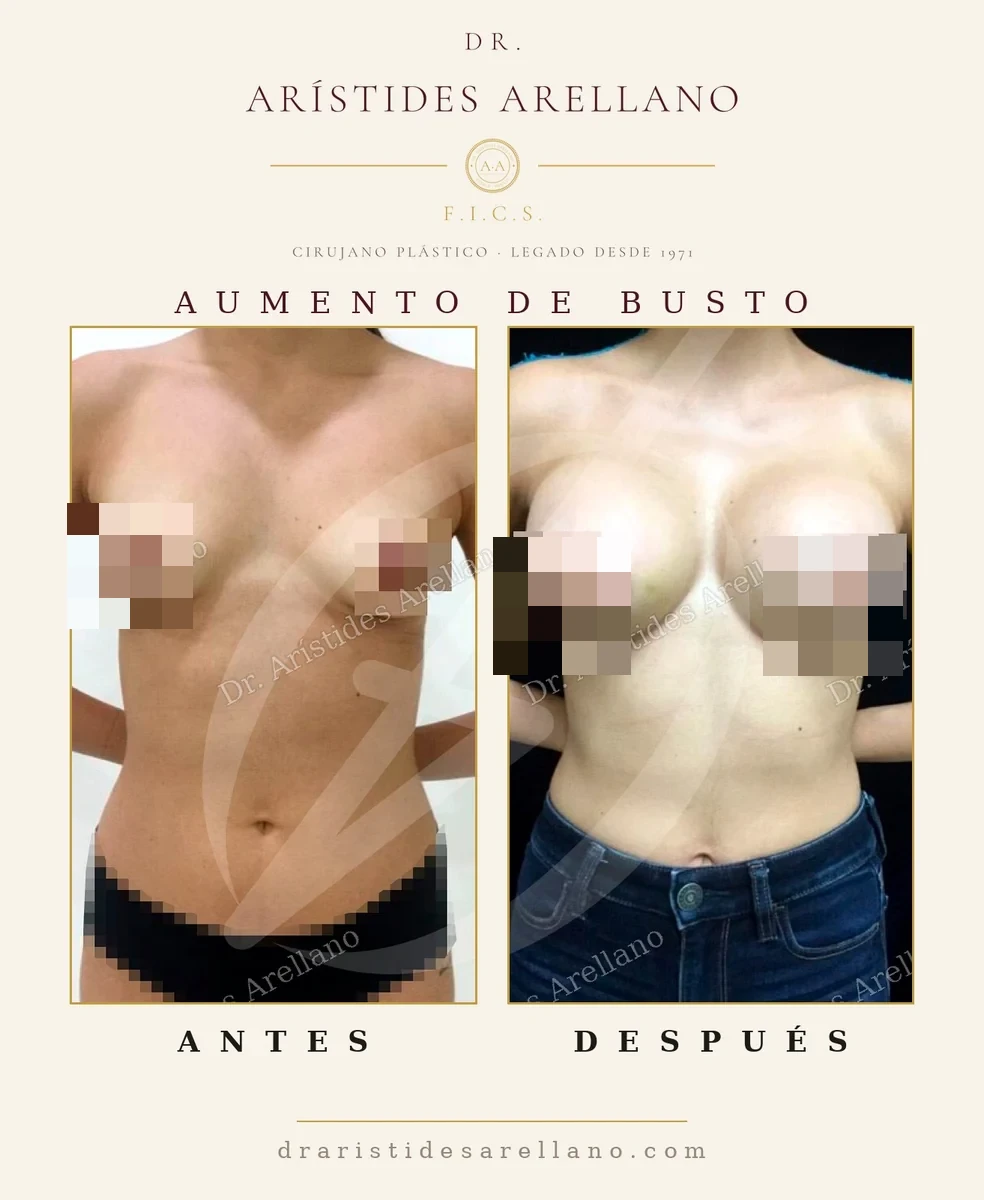
Where is the breast augmentation scar? Most often in the inframammary fold: a 4 to 5 cm line just under the breast, which the breast itself covers when standing. The other routes are the areolar border and the armpit. The choice is not only cosmetic: it determines how direct the access is and how the implant is positioned. All surgery carries risks and requires a prior medical assessment; results vary from person to person.
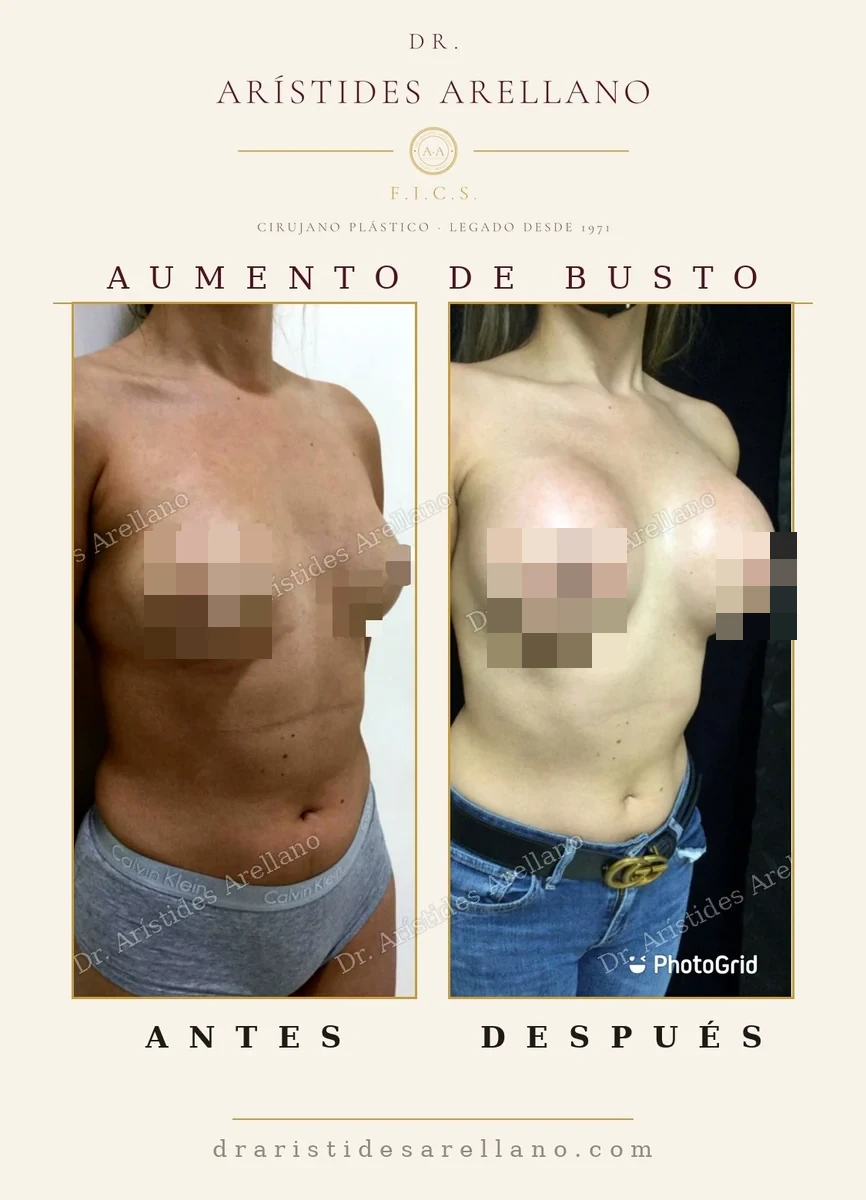
Does the implant go in front of or behind the muscle? Behind the pectoral muscle the upper edge is better disguised and the result looks more natural in slim women with little tissue; recovery hurts somewhat more. In front of the muscle recovery is faster and it suits patients who already have enough breast tissue. The decision comes from the skin pinch thickness, not preference. All surgery carries risks and requires a prior medical assessment; results vary from person to person.
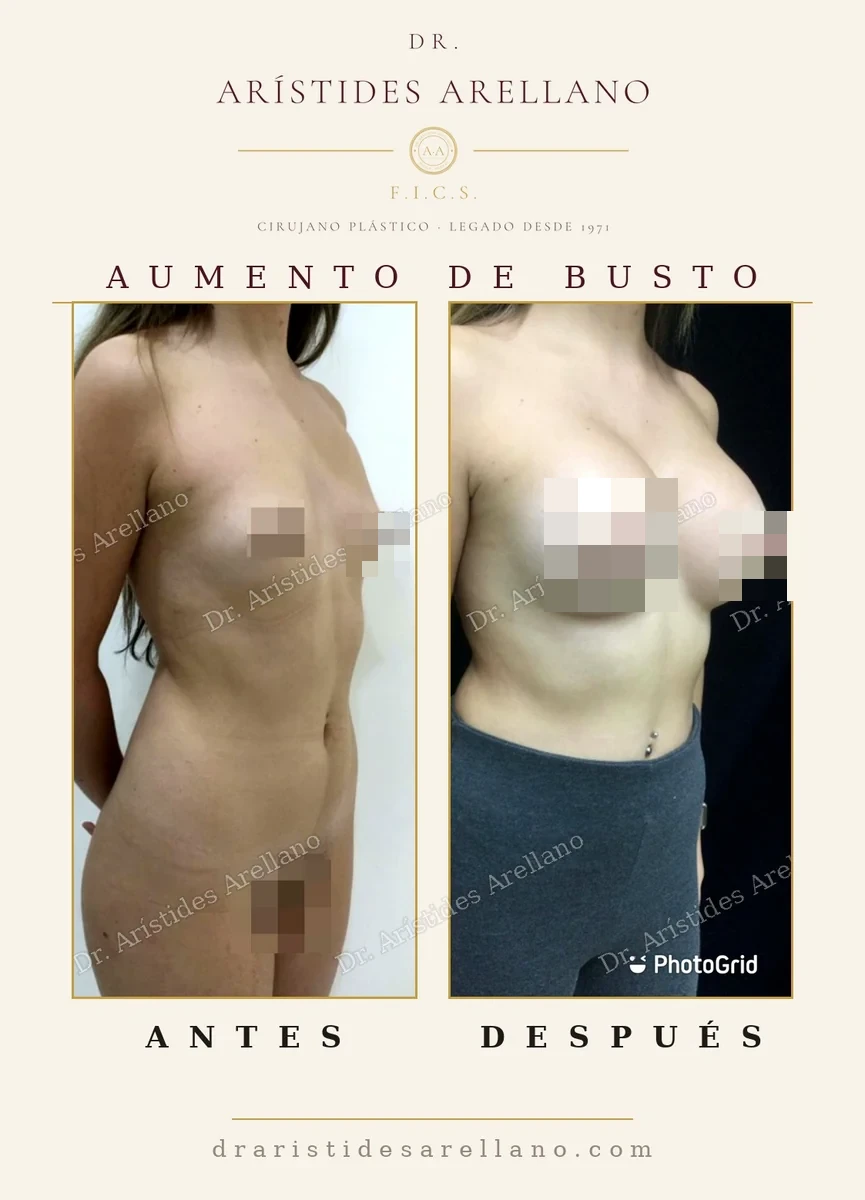
Will I still be able to breastfeed? In the great majority of cases, yes. The implant sits behind the gland, not inside it, and the ducts stay intact; the inframammary route disturbs glandular tissue least. Breastfeeding is never guaranteed one hundred per cent — it is not without surgery either — but a well-performed augmentation does not prevent it. All surgery carries risks and requires a prior medical assessment; results vary from person to person.
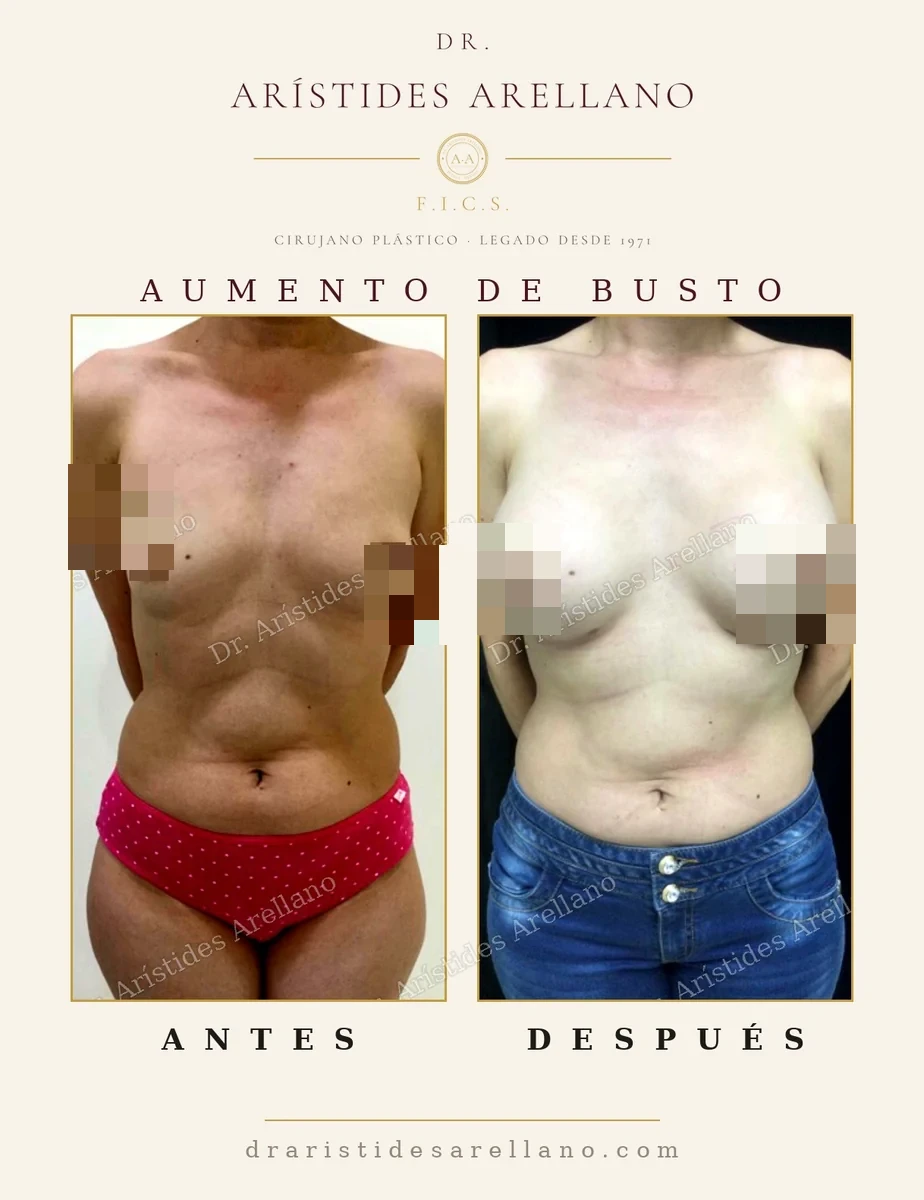
Can they look natural? What gives an augmentation away is not size, it is the upper pole: if the breast starts with a rounded, marked curve at the top, it shows. A moderate profile and a volume proportional to the chest give a straight upper slope, which is what an unoperated breast looks like. Asking for «the biggest that fits» is what produces the artificial look. All surgery carries risks and requires a prior medical assessment; results vary from person to person.
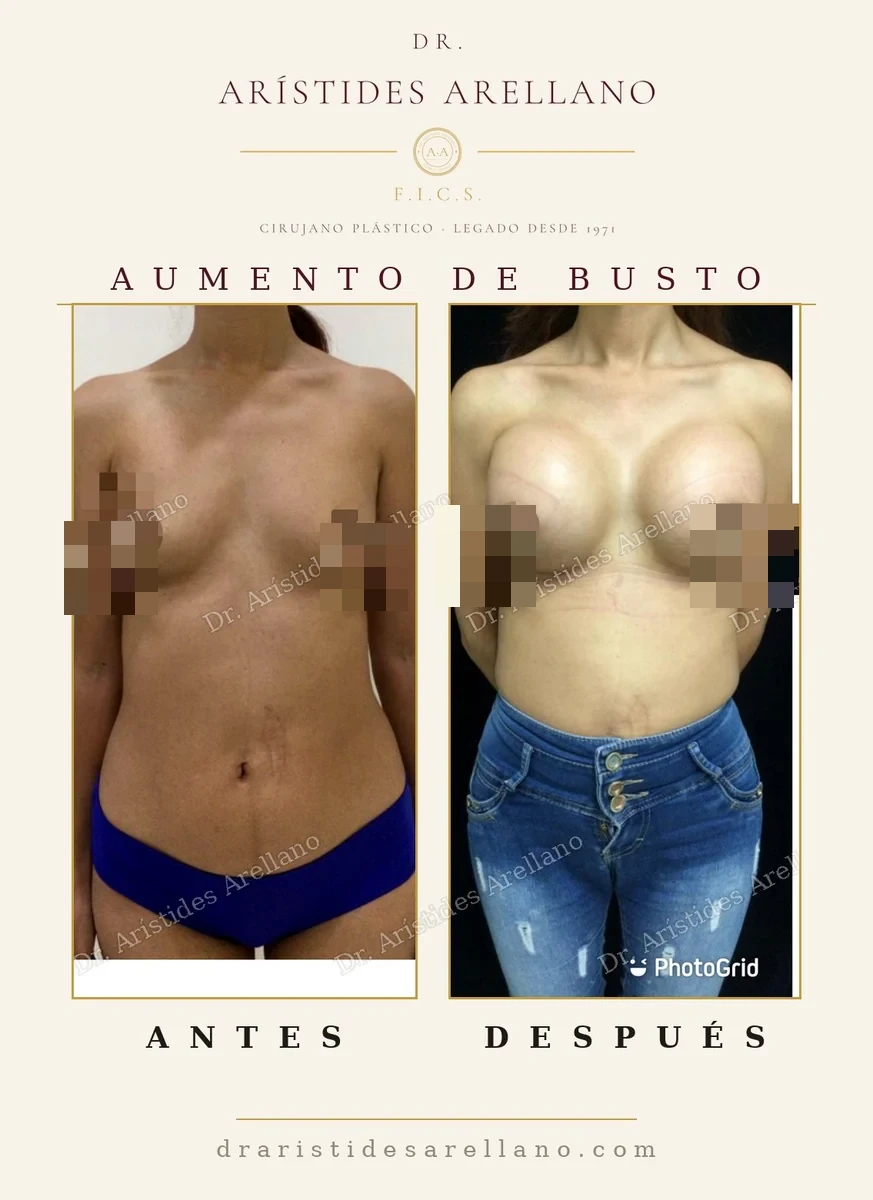
What cup size will I end up? No honest surgeon promises a letter. Bra sizing is not standardised — it varies between brands — and the same implant gives different results depending on chest width. What can be anticipated is proportion: at the consultation the breast base is measured and volumes are trialled to see the silhouette, not to promise a cup. All surgery carries risks and requires a prior medical assessment; results vary from person to person.
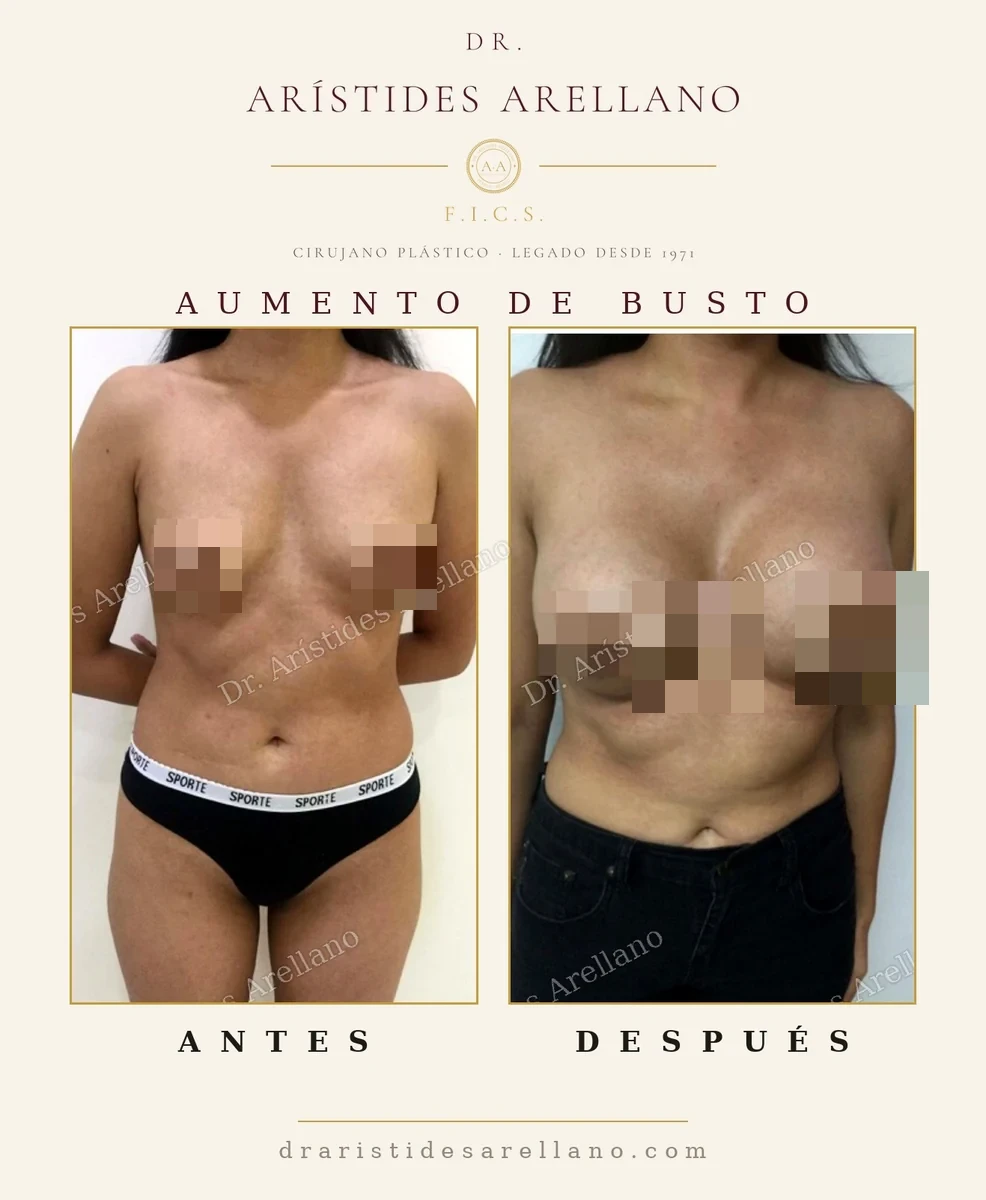
Does an implant lift a sagging breast? Only slightly, and only up to a point. The implant adds volume; if the nipple already sits below the inframammary fold, an implant alone pushes it further down and the result looks heavy. That case needs a lift (mastopexy) added, raising the nipple and removing skin. Here the sagging was mild and augmentation was enough. All surgery carries risks and requires a prior medical assessment; results vary from person to person.
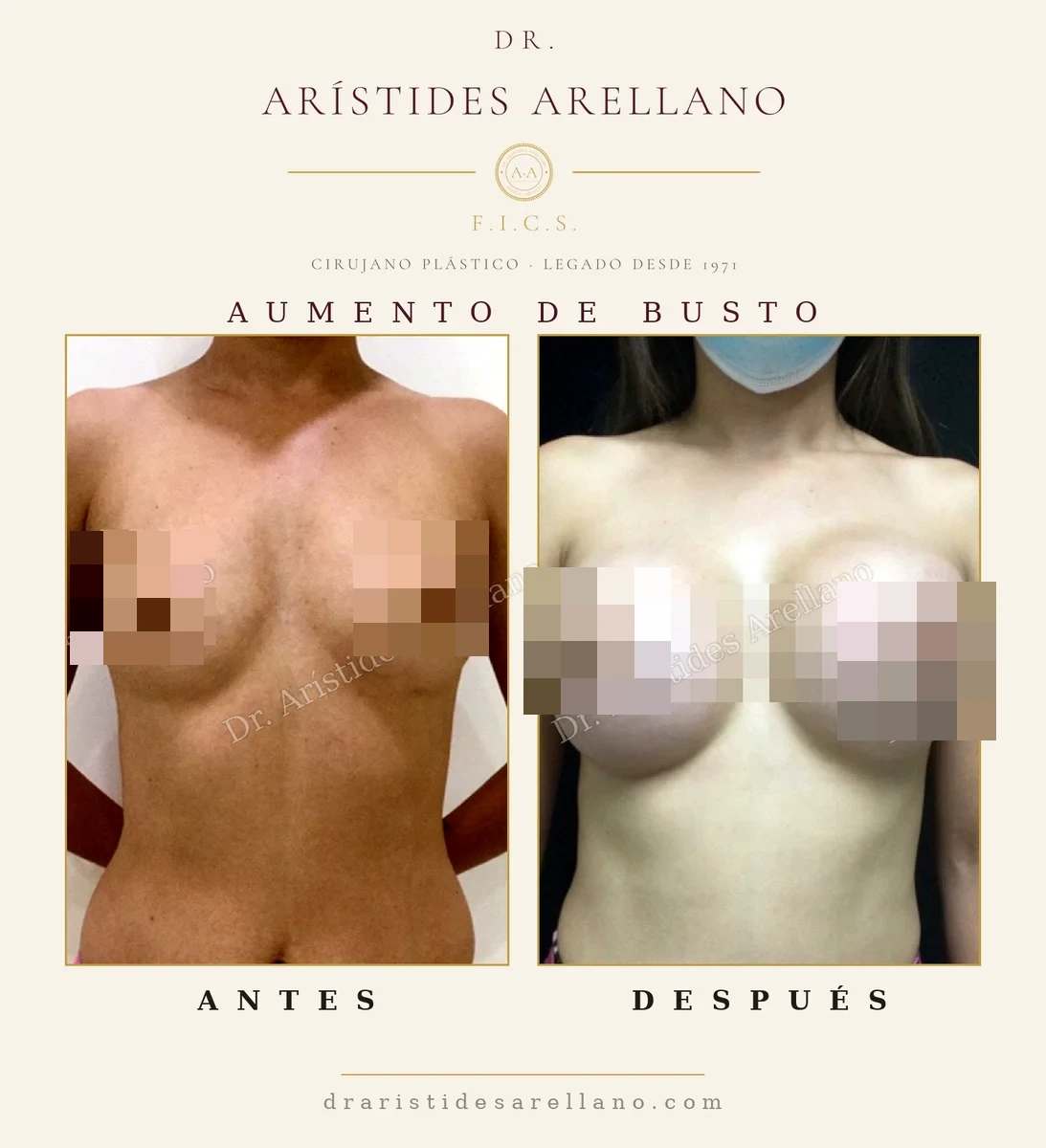
One breast is bigger than the other — can it be corrected? Yes, and it is more common than people think: almost no woman has two identical breasts. It is corrected using different implant volumes on each side, and sometimes by adjusting the fold position too. The realistic goal is that the difference stops showing when dressed, not perfect symmetry — which does not exist even before surgery. All surgery carries risks and requires a prior medical assessment; results vary from person to person.
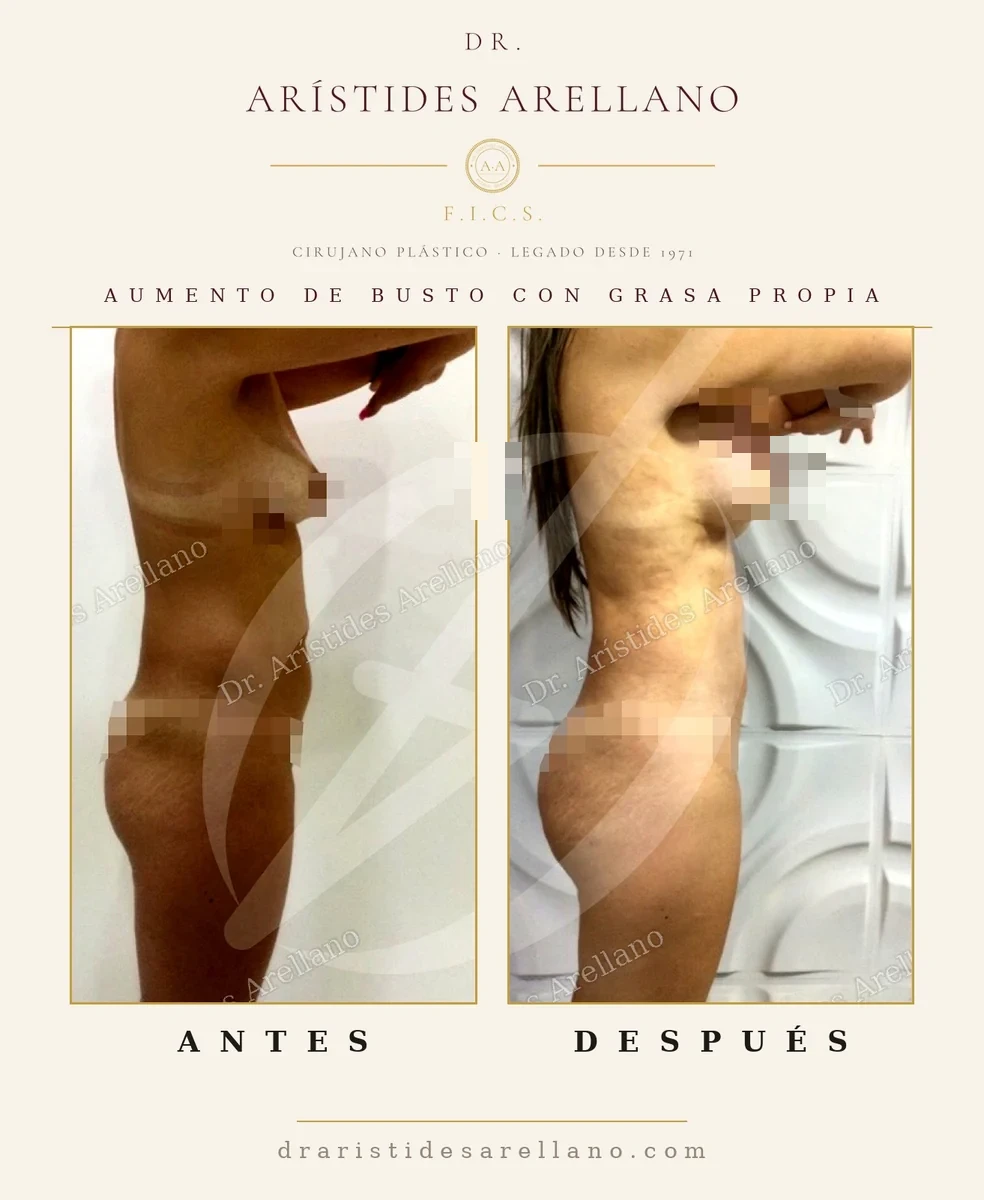
«I had a fat transfer and I see no results» — the most frequent complaint, and it has an explanation. Grafted fat reabsorbs by 30 to 50 % in the first six months; only the fat that establishes a blood supply survives. That is why fat transfer to the breast gives roughly one cup size, not three, sometimes needs a second session, and requires enough donor fat. Anyone promising a large jump in a single session is selling you the reabsorption as a result. All surgery carries risks and requires a prior medical assessment; results vary from person to person.
Photographs of real patients, published with their written informed consent. Results may vary from person to person; these images are not a promise of outcome.
Every case is different. Discuss yours in a personal consultation.
Book a consultation on WhatsAppEvery figure published on this site is approximate and is not a quote. Any procedure or treatment first requires a private assessment consultation with Dr. Arístides Arellano —$800 MXN, charged separately— and it is at that consultation that the definitive cost of your case is determined.
Educational content; it does not replace a medical consultation. Results may vary from person to person.